What It Does Not Do
The protections people ask about are in other laws, in other bills, or in rules the MPSC is writing now.
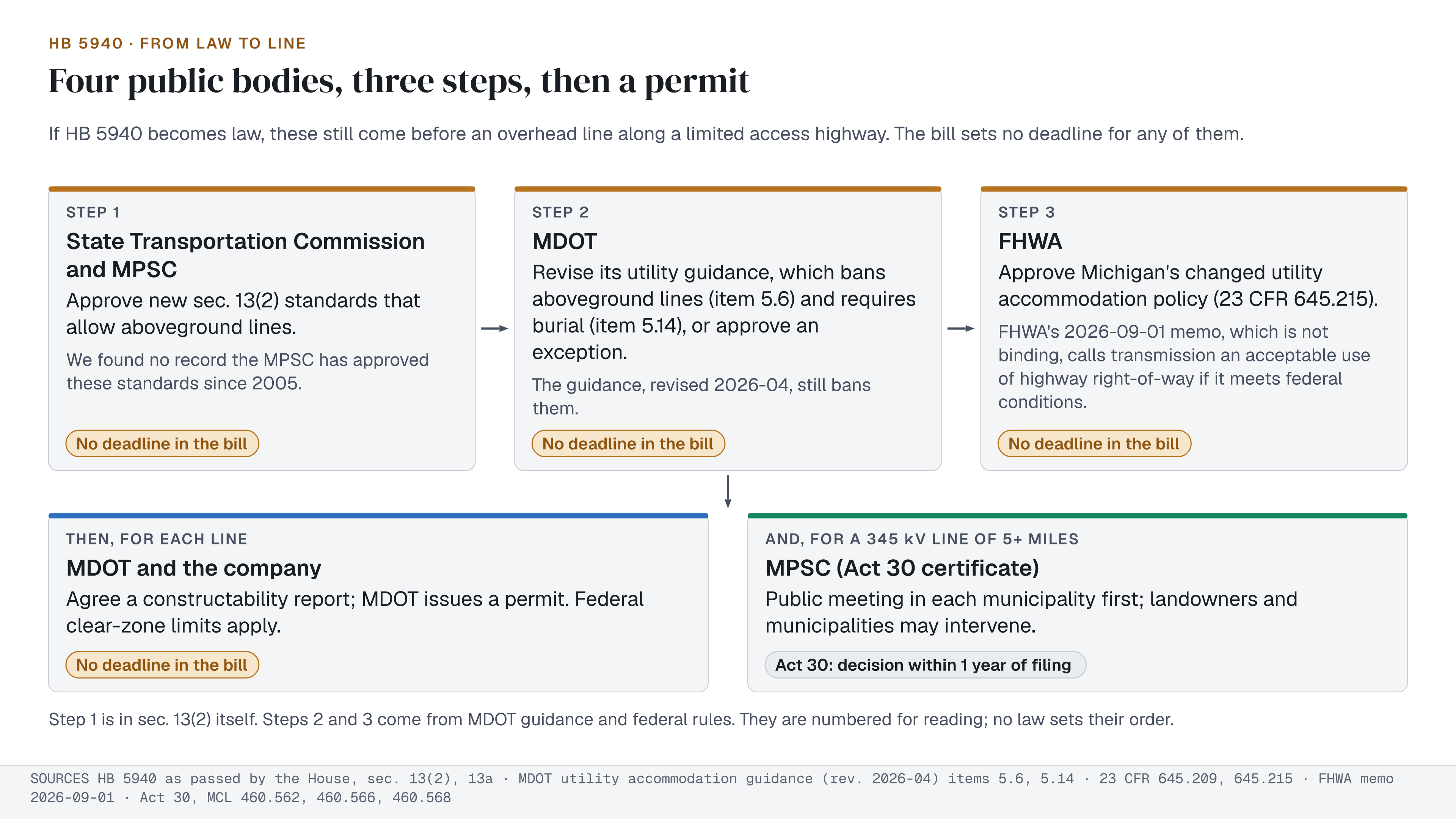
It does not change Act 30.
The MPSC still decides a major line's route. A highway route reaches the MPSC only as the company's route or alternate, or as another party's alternative. MCL 460.567 (2)(c) MCL 460.568
It does not give townships a say.
Cities, villages, and townships already have no consent role over utility lines in limited access highway right-of-way, and the bill does not change that. Every new duty in sec. 13a falls on MDOT alone. HB 5940 as passed 2:21-23 HB 5940 as passed 4:22-6:2
It does not notify neighbors.
No version of sec. 13a gives notice to landowners, townships, or counties. Its only notice runs to the line company: as introduced, to "the utility"; after H-2, to the company that asked to collocate. HB 5940 as introduced 5:20-23 HB 5940 as passed 5:23-6:2
It does not say who pays to move a line.
It sets an agreed no-relocation period "as it is practicable", and is silent on cost. HB 5940 as passed 5:18-22
It does not change the fee or share it.
The fee rule stays as it is. The standards "may provide for the imposition of a reasonable charge": a 1-time permit fee of at most $1,000 per mile, with a $5,000 minimum, plus any permit cost the fee does not cover. All of it goes to limited access highway costs; local units get none. HB 5940 as passed 2:29-3:14
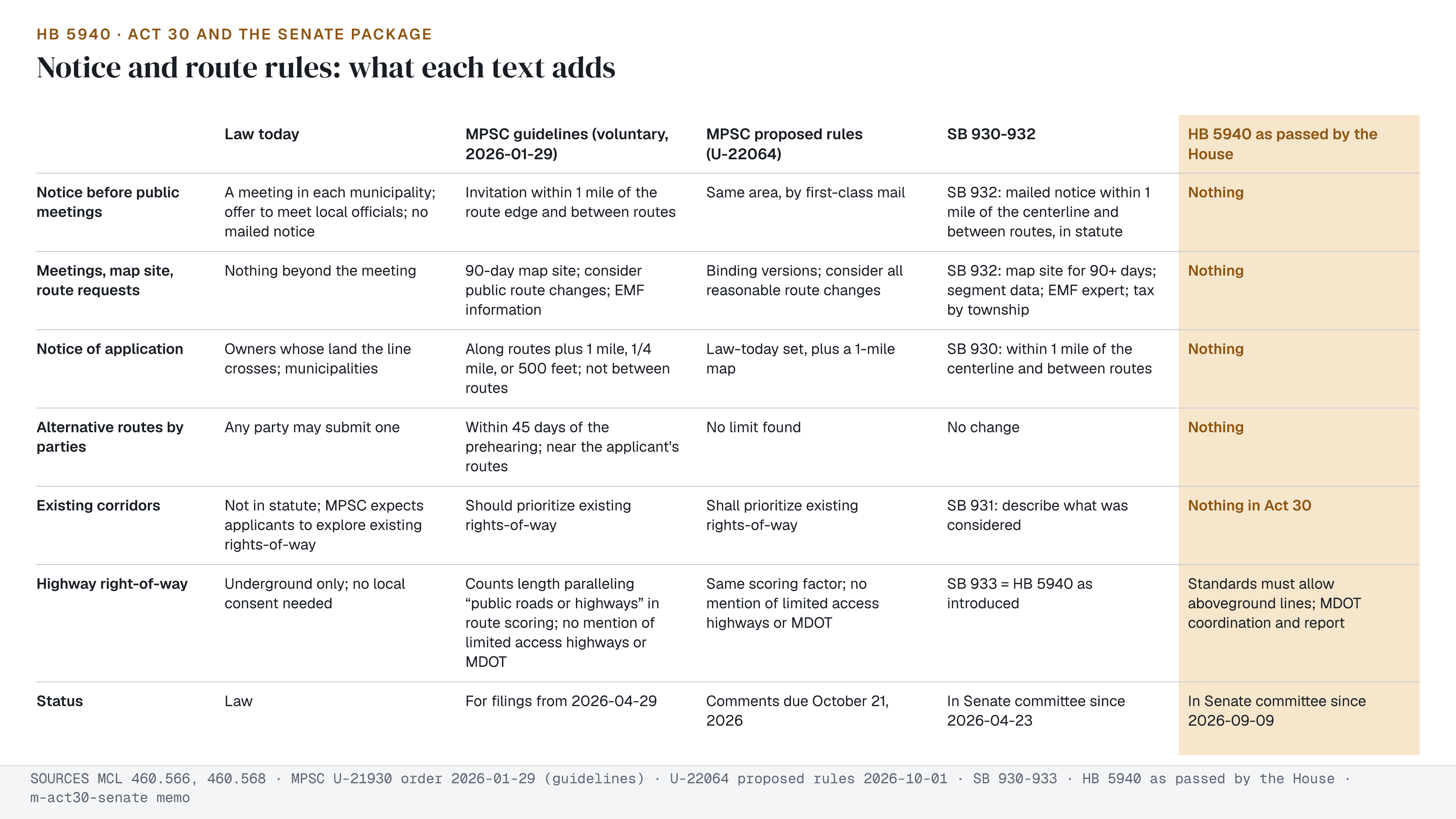
SB 930-933 were introduced on April 23, 2026, 19 days before HB 5940. HB 5940 matches only SB 933. SB 930-932, the bills on notice and route choice, have had no hearing. SB 933 Bill history Senate committee
HB 5940 (as passed)
If enacted, would end the statutory underground rule; adds MDOT's sec. 13a process for utilities and the two Act 30 transmission company types. HB 5940 as passed Senate Journal 67
Notice: None to the public.
Status: Passed House 98-0; in Senate Energy and Environment.
SB 933 (Bayer)
HB 5940 as introduced, word for word, from the same drafting request, including the same strike and the 5-year relocation notice. SB 933
Notice: None to the public.
Status: Introduced April 23, 2026; no action since.
SB 930 (Singh, Bayer)
Amends Act 30 notice of an application. SB 930
Notice: Mailed notice to municipalities and landowners along, within 1 mile of the centerline of, and between the proposed and alternate routes.
Status: Introduced April 23, 2026; no action since.
SB 932 (Bayer, Singh)
Amends Act 30 pre-application meetings: a public map website for at least 90 days, segment data, documented answers to route requests. SB 932
Notice: Mailed notice to the same 1-mile set.
Status: Introduced April 23, 2026; no action since.
SB 931 (Singh, Bayer)
Asks applicants to describe how they chose the route, including whether they considered paralleling existing rights-of-way. Its catch title says “require to use”, but the text requires only a description. SB 931
Notice: No change.
Status: Introduced April 23, 2026; no action since.
MPSC guidelines (2026, voluntary)
Applicants “should prioritize the use of existing ROWs”. The order adopting them found it 'reasonable to require' parties to propose any alternative route within 45 days after the prehearing conference. MPSC U-21930 pp. 28-31
Notice: Not addressed here.
Status: Adopted January 29, 2026, for applications from April 29, 2026.
MPSC proposed rules (binding if adopted)
An applicant “shall prioritize the use of existing” rights-of-way. Neither the rules nor the guidelines mention limited access highways or MDOT; both count length paralleling 'public roads or highways' only as a route-scoring factor. MPSC U-22064
Notice: Open for comment.
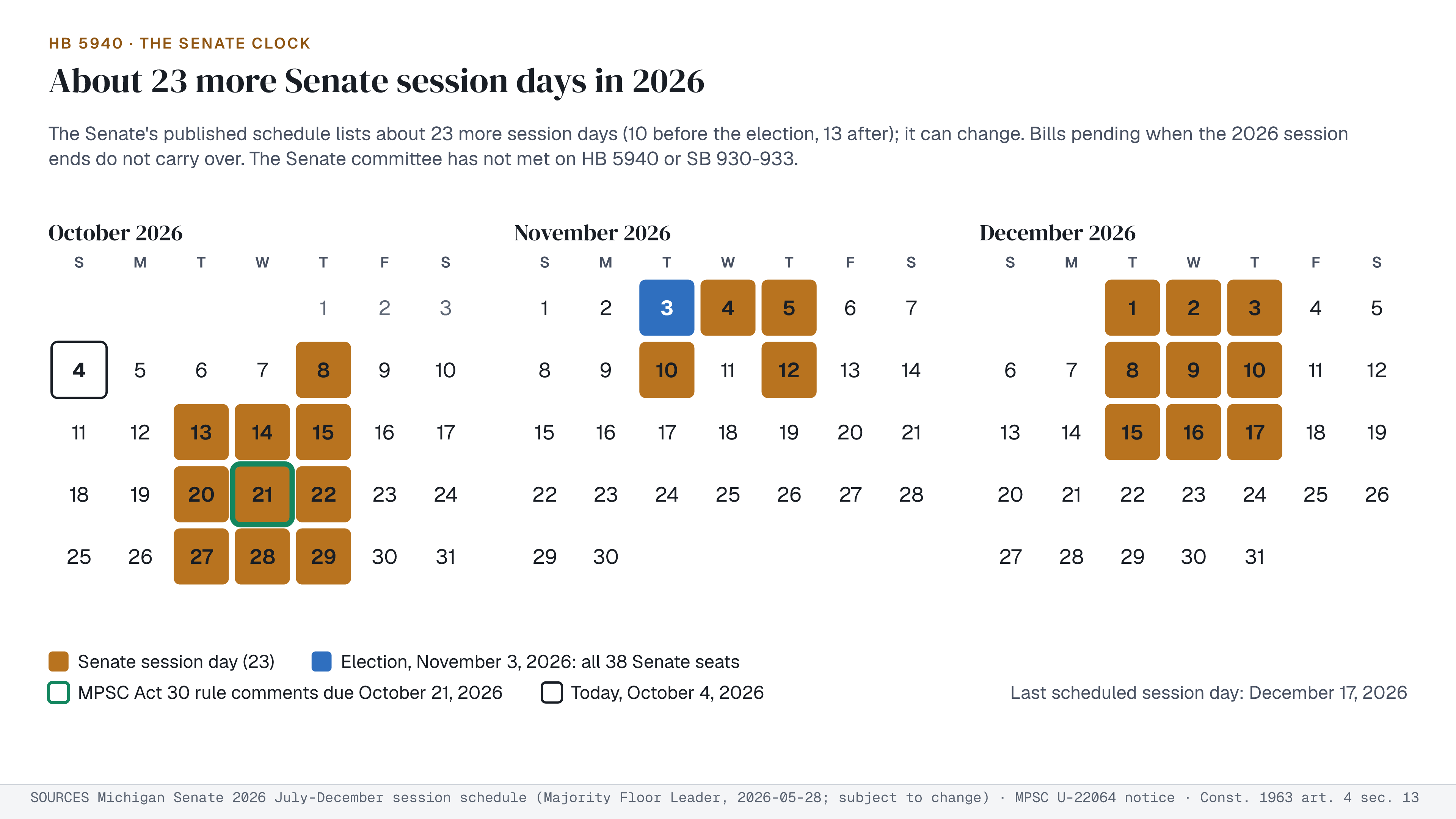
Status: Proposed October 1, 2026; comments due October 21, 2026.