
Michigan utility decisions · October 2026
Michigan Public Service Commission
A three-member Commission makes decisions under laws passed by the Legislature. Meet the commissioners and follow the history, appointments, evidence, and public process behind utility orders.
Find the decision that affects you
Begin with the law,
then follow the evidence.
Identify the facility, the decision maker, and the request. The detailed chapters below connect the governing law to the records and actions that matter.
Watch the explanation
Follow the law,
then the decision.
Branded, narrated explanations with animated diagrams, original documents, and downloadable captions and transcripts.
1:05 · 9:16 vertical
The vertical Short

7:13 · 16:9 wide
The detailed explanation

People and current records
Who holds the offices?
Official biographies explain backgrounds and terms. Assess individual decisions through the record and written order.

Chair · Democrat
Dan Scripps
Current term ends July 2, 2029. Legal, legislative, and energy-policy background.

Commissioner · Independent
Katherine Peretick
Current term ends July 2, 2027. Engineering and energy-storage background.

Commissioner · Democrat
Shaquila Myers
Current term ends July 2, 2031. Executive and legislative policy background.
Evidence cutoff: October 7, 2026. Read the later docket before acting. The source-linked report and chapters identify the controlling records.
A guide you can work through
Read the process
in order.
Start with the foundation, then follow the stages. Each chapter identifies the law and the records behind its claims.
Chapter 1
What the Commission does
Start with the decision that affects you
A higher electric bill raises a rate and tariff question. A new transmission route raises a certificate question. A gas pipeline can raise construction and safety questions. A data center can raise a special-contract question and later supply or cost-recovery questions. One project can appear in several proceedings. 11011
The Commission does not govern every utility-like service or every project permission. Municipal utilities and member-regulated electric cooperatives have important rate exceptions. Michigan no longer regulates retail telecommunications rates. Cellular, broadband, and internet services are generally excluded from its stated authority. Environmental permissions, local land use, and federal energy decisions can involve other bodies. 101112
An order is the agency's decision
The commissioners exercise their authority collectively. Professional staff examine filings and offer recommendations. Administrative law judges manage contested proceedings and prepare recommendations where applicable. The utility supplies proposals and evidence. None of these roles makes a press release or a staff recommendation equivalent to the final written order. 1314
Begin with the statute establishing authority, then read the application and procedural schedule, then the issued order. A familiar project name is not enough to identify what has actually been decided. 114
Chapter 2
How the institution changed
Railroad roots, then new services
Michigan created a railroad commission in 1873 with one commissioner. The commission expanded to three members in 1909. Electricity and telephone responsibilities arrived in the following years. These changes reflected legislative choices about which services required state oversight. Today's agency is the product of that history, rather than an organization whose authority has always been the same. 4
The Michigan Public Utilities Commission succeeded the earlier institution in 1919 with five members. In 1939, the Legislature created the Michigan Public Service Commission. The current foundational law is Act 3 of 1939, as amended. The 1939 institution initially had five commissioners. 14
The modern three-member structure
In 1947, the structure became three commissioners with staggered six-year terms. In 1951, the law limited membership to no more than two commissioners from the same political party. These structural rules still shape appointments and continuity. They do not require equal numbers from each party or a particular vote in an individual case. 14
Later statutes and amendments changed regulation of gas, electricity, telecommunications, renewable resources, and other matters. The Commission's historical overview is a guide to those institutional changes. A present legal question still requires the current governing statute, rather than a general account of the agency's mission. 14101112
Chapter 3
The current commissioners and appointments
Three people hold the decision-making offices
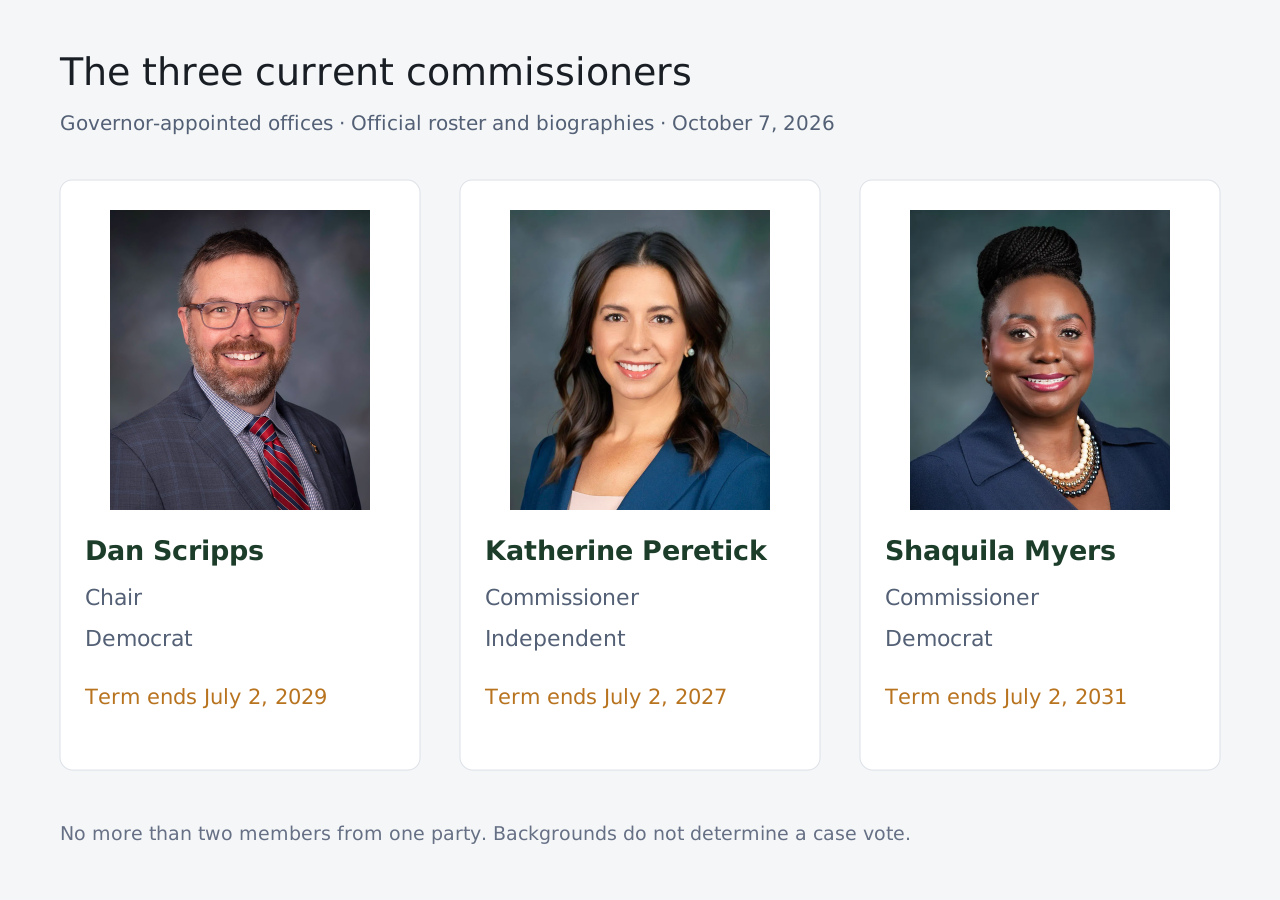
At the October 7, 2026 cutoff, the official Commission roster lists Dan Scripps, Katherine Peretick, and Shaquila Myers. All three were appointed by Governor Gretchen Whitmer. The roster lists Scripps and Myers as Democrats and Peretick as an Independent, consistent with the two-from-one-party limit. 5678
Dan Scripps was appointed February 21, 2019, and designated chair in July 2020. His reappointment term expires July 2, 2029. His official biography describes legal, legislative, and energy-policy experience. Katherine Peretick was appointed January 4, 2021; her current term expires July 2, 2027. Her biography describes engineering and energy-storage experience. Shaquila Myers was appointed July 21, 2025, with a term expiring July 2, 2031. Her biography describes executive and legislative policy experience. 5678
These biographies establish publicly stated backgrounds. They are not evidence that a commissioner will vote a particular way. Assess a case through its record and votes rather than inferring an outcome from a résumé or party designation. 5678
Michigan's Senate process uses a disapproval period
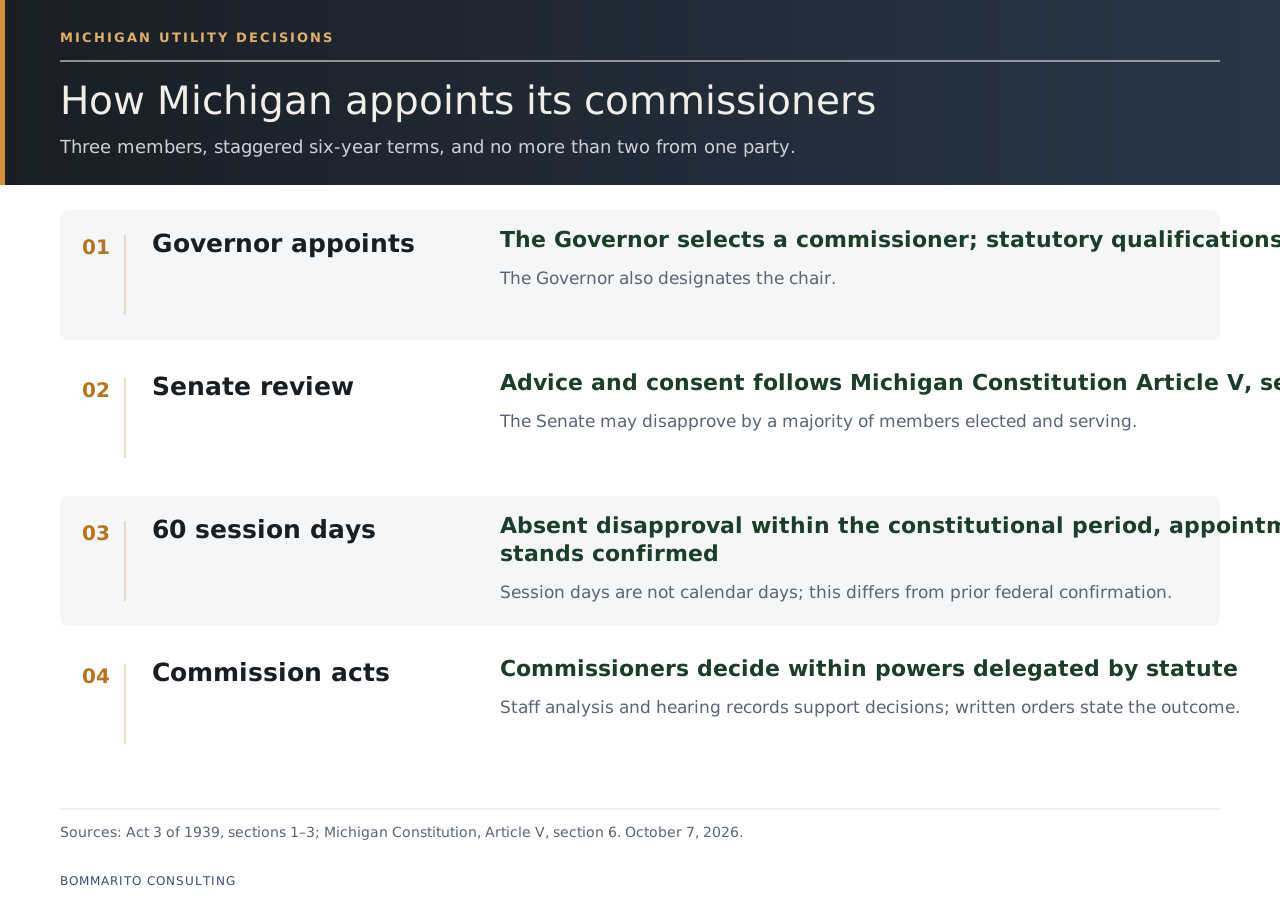
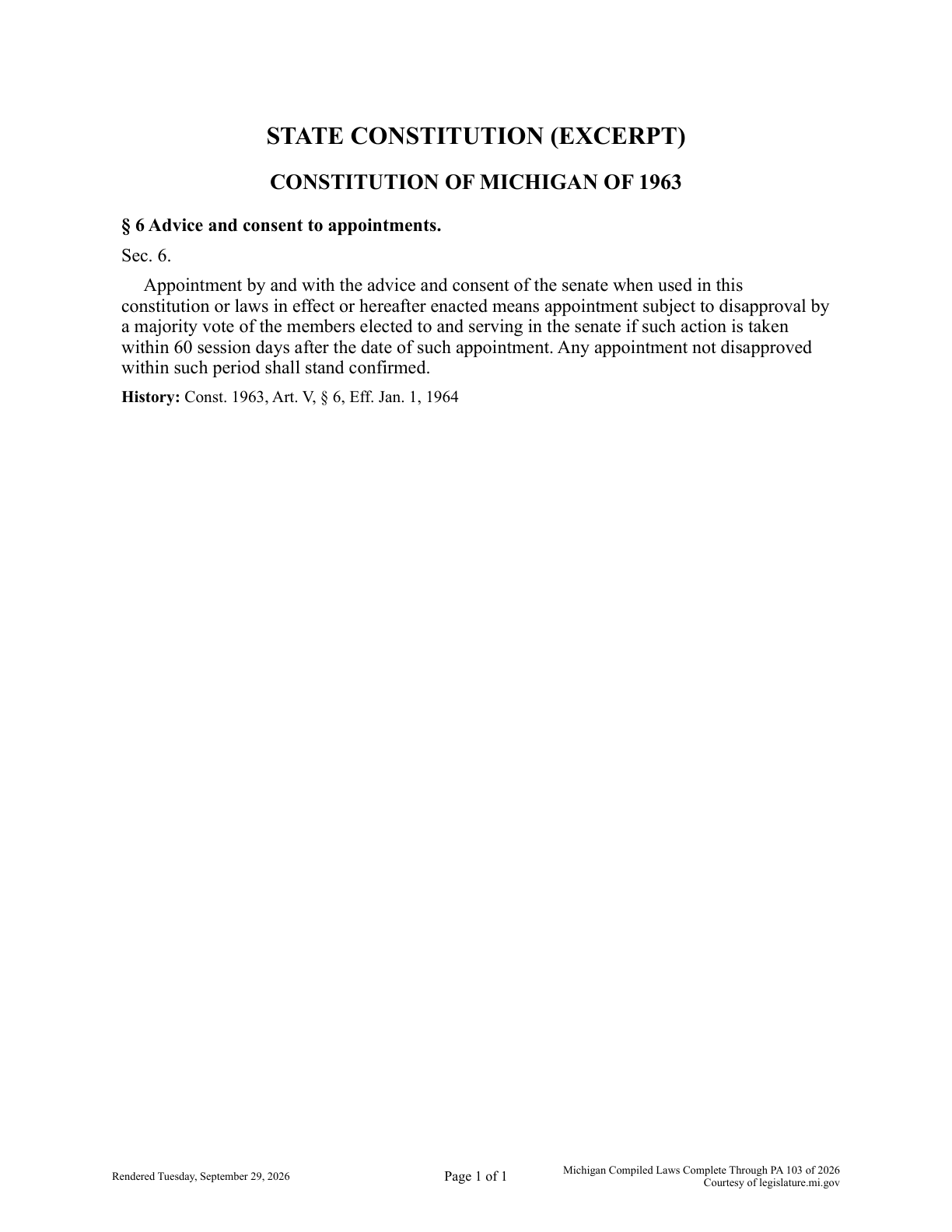
The Governor appoints commissioners with Senate advice and consent. Michigan Constitution Article V, section 6 defines that process as appointment subject to disapproval by a majority of the Senate's elected and serving members within 60 session days. An appointment not disapproved within that period stands confirmed. Session days are not calendar days. This is not a requirement for prior federal-style confirmation. 12
The Governor designates the chair. Terms are staggered to provide continuity across appointments. Elections can affect the appointing Governor and Legislature, but residents do not elect commissioners directly. 12
Statutory safeguards constrain the office
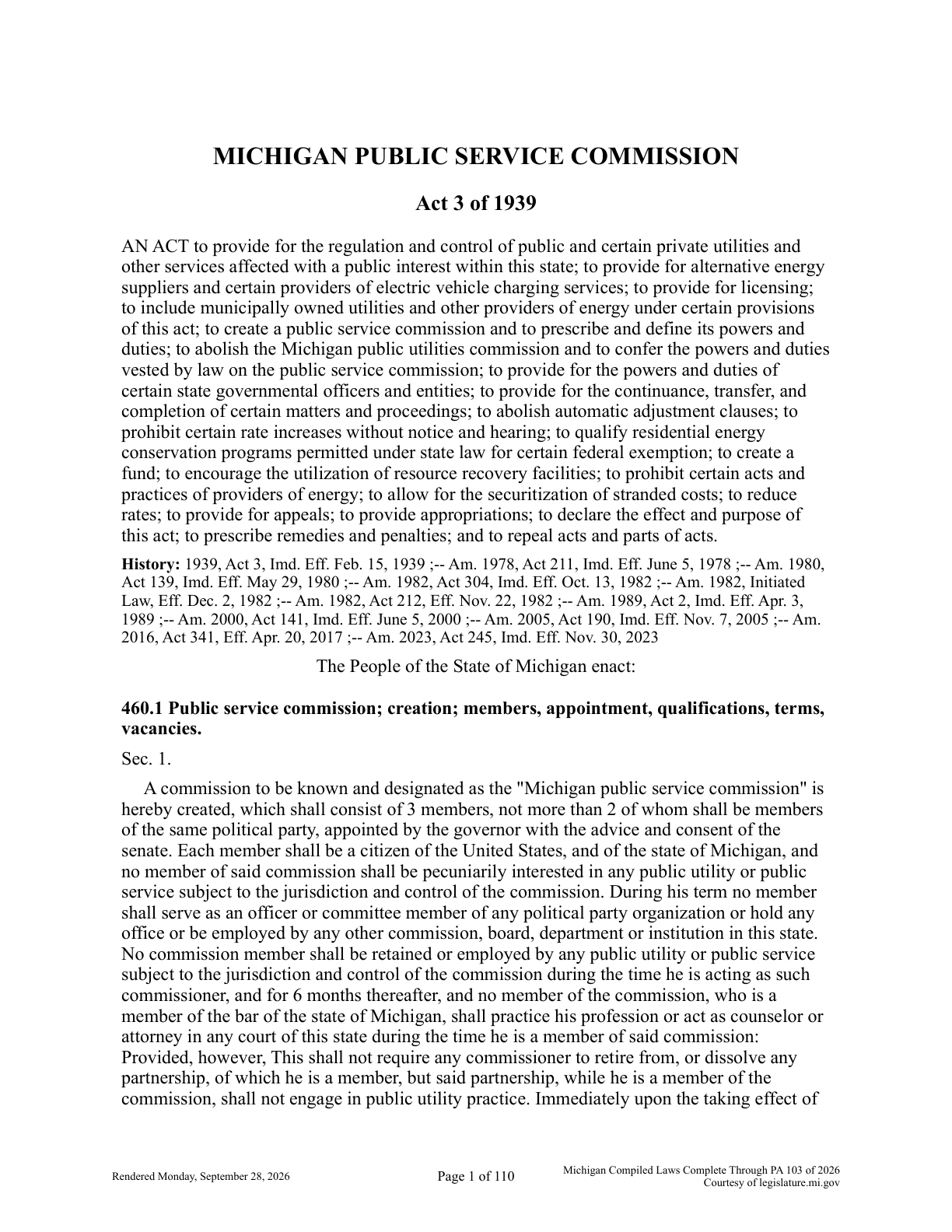
Act 3 includes citizenship and residency qualifications, limits on pecuniary interests in specified regulated utilities, political-party office restrictions, and restrictions on other state office or employment. It also restricts specified utility retention during service and for six months afterward. Read the actual provision for its scope; the rule is not accurately summarized as a ban on every investment or all employment forever. 1
Chapter 4
From application to written order
A case number points to a record
Many proceedings have a number beginning with U-. The record can include an application, exhibits, testimony, notices, procedural rulings, public comments, proposed decisions, briefs, and Commission orders. A list of cases is an index into this evidence, not a substitute for reading it. 14
Contested cases allow parties to present and challenge evidence under the applicable procedures. Administrative law judges handle hearing functions; staff may participate in reviewing the proposal. The commissioners decide the matter through an order within their statutory authority. Different proceedings have different clocks and participation rules. 114
Rates need more than a requested percentage
A utility rate case examines its revenue requirement and how costs are allocated. Revenue requirement is the total amount the utility seeks to recover through approved rates. A customer's bill depends on the applicable tariff and usage. A requested annual revenue increase is not the percentage change in every household's bill. 11
Transmission certificates, renewable-facility certificates, integrated resource plans, gas supply cost proceedings, and special contracts answer different questions. Approval of one does not necessarily approve every expense or permission associated with the project. 11011
Decisions can change on review
Rehearing, later Commission proceedings, and judicial review can change the legal position. A historical order may remain available online after its effect changes. Read later orders and appellate dispositions before treating an older approval as current authorization. This overview is not a complete citator for every Commission decision. 114
Chapter 5
Policy, appointments, and public accountability
The Legislature supplies the framework
Statutes set the agency's powers, goals, standards, and procedures. Amendments can change which projects qualify for a certificate, the required findings, or the timing of a review. An agency guideline, proposed rule, adopted rule, and enacted statute have different legal roles. 110
The Governor's appointments shape the composition of the Commission. The Senate exercises its constitutional review role. These political processes coexist with case-specific records and legal constraints. Party membership does not itself establish whether a particular application satisfies the governing statute. 125
Public meetings and public records make decisions inspectable
Commission orders, case records, public meetings, and annual reports help residents understand what the agency did. The 2025 annual report describes the agency's work across its responsibilities. It is useful for institutional context; the controlling source for a particular approval remains its own order and governing law. 914
Transparency also requires knowing which question an agency cannot decide. A local zoning concern, environmental permit, easement dispute, or federal pipeline certificate may require another forum. Sending every concern to one agency can miss the body with authority to grant the requested relief. 101112
Public accountability works through both broad policy choices and specific evidence. Residents can engage elected officials about statutes while participating in the relevant case about a utility proposal. Those are related but separate actions. 121314
Chapter 6
Choose a complaint, comment, or party role
A service complaint starts with the utility
For a billing or service problem, begin with the utility's customer process and keep account records, bills, dates, and correspondence. The Commission's complaint channel addresses matters within its jurisdiction. Identify the service and provider before assuming every communications or utility dispute belongs there. 101215
Comments identify concerns
A public comment can describe an impact, identify a missing record, or request an explanation. Use the case number and the stated filing instructions. A useful comment links the concern to the decision under review and supplies concrete facts. It does not automatically confer the procedural rights of a party. 1314
Intervention is formal participation
Intervenors become parties under the applicable law and procedural rules. Eligibility, filing deadlines, representation, testimony, and other responsibilities depend on the proceeding. Some siting statutes provide rights for specified affected owners or local units. Do not transfer a right or clock from one statute to another. 11314
A practical starting file contains the statute, application, route or site maps, procedural order, issued decisions, and later review history. Then write the specific question: what should the decision maker approve, deny, condition, or require evidence about? 1314
Open MPSC is an independent archive and access layer created by Bommarito Consulting; it is not the Commission or the State of Michigan. Use its search and API to find records, then check the official document and current procedural state. An archive's status label cannot establish construction completion or the outcome of an appeal.
Original evidence
Read the documents.
These are rendered pages from the retained original PDFs. Open the full source to read definitions, exceptions, and the complete disposition.
Keep the record together
The detailed report
14 pages with cited chapters, decision diagrams, background illustrations, insets, and a source register.
Sources and primary authorities · 15 records
- 1Act 3 of 1939: Michigan Public Service Commission ↗
Primary source · Checked October 7, 2026
- 2Michigan Constitution Article V section 6 ↗
Primary source · Checked October 7, 2026
- 3About the MPSC ↗
Primary source · Checked October 7, 2026
- 4Commission history ↗
Primary source · Checked October 7, 2026
- 5Commission membership and party affiliations ↗
Primary source · Checked October 7, 2026
- 6Chair Dan Scripps official biography ↗
Primary source · Checked October 7, 2026
- 7Commissioner Katherine Peretick official biography ↗
Primary source · Checked October 7, 2026
- 8Commissioner Shaquila Myers official biography ↗
Primary source · Checked October 7, 2026
- 92025 MPSC Annual Report ↗
Primary source · Checked October 7, 2026
- 10MPSC regulatory responsibilities ↗
Primary source · Checked October 7, 2026
- 11MCL 460.6a: rate decisions ↗
Primary source · Checked October 7, 2026
- 12MPSC telecommunications responsibilities ↗
Primary source · Checked October 7, 2026
- 13MPSC Get Involved ↗
Primary source · Checked October 7, 2026
- 14MPSC case and hearing information ↗
Primary source · Checked October 7, 2026
- 15MPSC consumer complaints ↗
Primary source · Checked October 7, 2026
Prepared by Bommarito Consulting from public statutes, original orders, official court opinions, and agency records. Open MPSC is an independent access layer and is not affiliated with the Commission or State of Michigan. Illustrations explain the process; they do not depict surveyed sites or final engineering designs.