
Michigan utility decisions · October 2026
Michigan gas and petroleum pipelines
What the pipe carries changes which law applies. Follow natural gas and petroleum through siting, safety, courts, land rights, and customer costs.
Find the decision that affects you
Begin with the law,
then follow the evidence.
Identify the facility, the decision maker, and the request. The detailed chapters below connect the governing law to the records and actions that matter.
Watch the explanation
Follow the law,
then the decision.
Branded, narrated explanations with animated diagrams, original documents, and downloadable captions and transcripts.
1:10 · 9:16 vertical
The vertical Short
7:44 · 16:9 wide
The detailed explanation
People and current records
What has actually happened?
A proposal, certificate, court disposition, and operating facility are different states. Keep the status beside the project name.
Natural gas · U-22248
Line 300
Consumers Energy filed its rerouted gas-segment application in September 2026. An open application is not merits approval.
Petroleum · U-20763
Line 5
The July 31, 2026 Supreme Court opinion vacated the historical approval and remanded for further review.
Evidence cutoff: October 7, 2026. Read the later docket before acting. The source-linked report and chapters identify the controlling records.
A guide you can work through
Read the process
in order.
Start with the foundation, then follow the stages. Each chapter identifies the law and the records behind its claims.
Chapter 1
Start with what the pipe carries
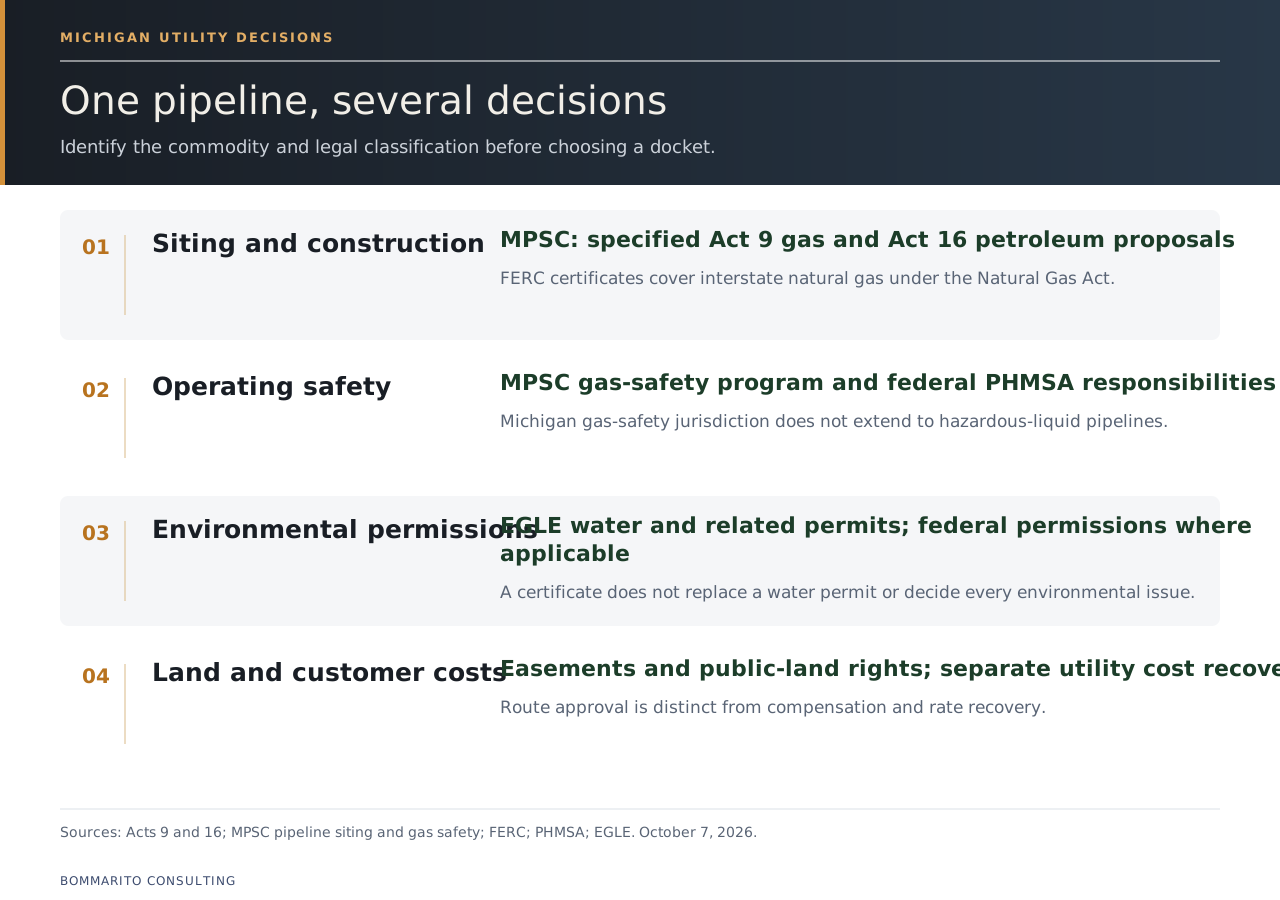
Several decisions can concern the same pipe
A pipeline project may need approval of its route and construction, operating safety oversight, environmental permits, and rights to use land. A utility may also seek permission to recover its costs from customers. Each decision has a different record and legal test. Participation in a water-permit hearing does not automatically make you a party in the pipeline siting case. 345671213
Natural gas commonly moves from supply and storage facilities through transmission mains and local distribution networks. A transmission main carries gas between places where it is supplied and used. Local distribution delivers gas to customers. The project's classification and proposed work matter; the word “pipeline” alone is too broad to identify its approval pathway. 13456
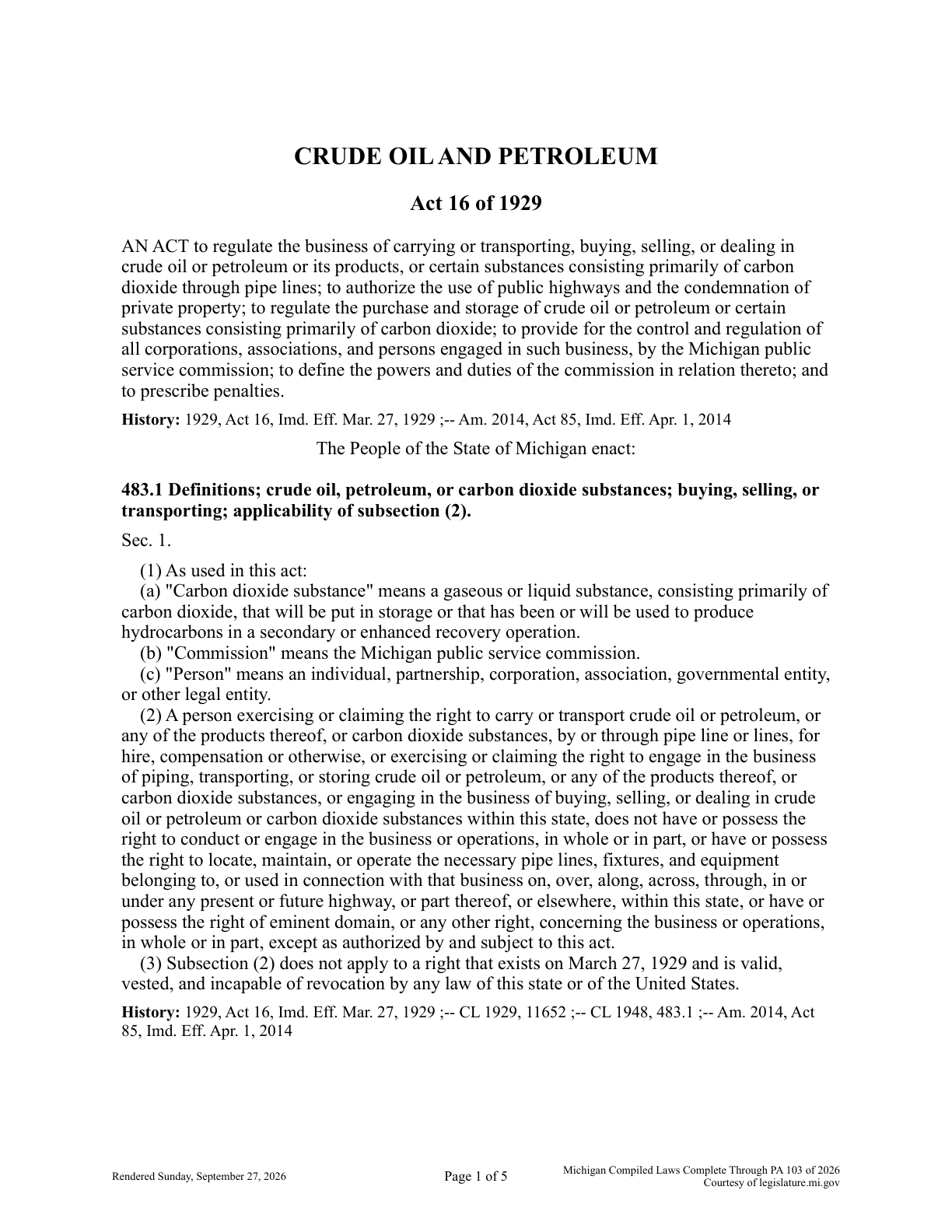
Petroleum pipelines carry a different commodity. Line 5 carries crude oil and natural gas liquids. Natural gas liquids are products separated from natural gas, including feedstocks used to make propane. That connection to gas does not convert Line 5's replacement application into an Act 9 natural-gas case. The application was made under Act 16. 289
Interstate is a legal boundary, not just a map label
FERC, the Federal Energy Regulatory Commission, reviews construction and operation applications for interstate natural-gas pipelines under section 7 of the Natural Gas Act. Its safety responsibilities differ from its certificate responsibilities. FERC also has limited transportation authority over some intrastate facilities that participate in interstate gas flows. A line's legal status requires more than observing whether a mapped segment crosses the state border. 56
For a Michigan intrastate natural-gas proposal, start with Act 9 and the MPSC record. For crude oil or petroleum, examine Act 16. Then identify the separate federal and state safety, environmental, and land-rights requirements. 1234567
Chapter 2
Natural gas and Act 9
What an application must explain
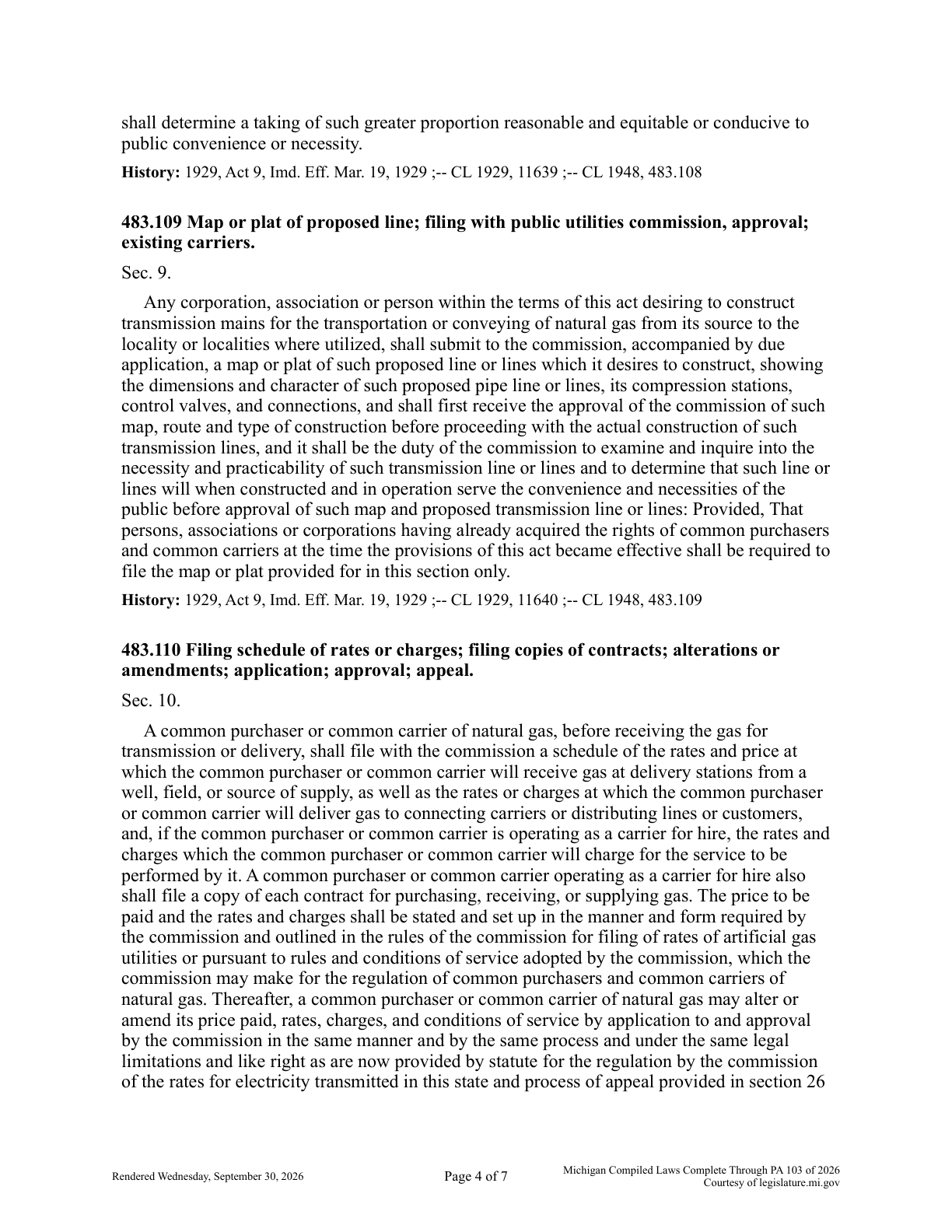
MCL 483.109 calls for the proposed line's map or plat, dimensions, character, compression stations, control valves, and connections. The Commission reviews the map, route, and type of construction. This is a route-and-design inquiry, not merely permission to draw a line between two endpoints. The section contains a proviso for specified existing common purchasers and carriers; do not omit it when applying the statute to a particular operator. 1 (section 9)
Necessity asks why the proposed facility is needed. Practicability asks whether the proposal can work. Public convenience and necessities concern the public service the line will provide. Useful evidence can include the demand problem, pressure or capacity requirements, alternatives, route constraints, crossing methods, and construction design. Those subjects organize an inquiry; they do not replace the statutory words or create a mandatory scoring formula. 13 (section 9)
Compare alternatives on the same basis
A route beside an existing road may reduce private-land disturbance. It can also introduce crossing, traffic, access, or corridor-width constraints. A route across private property may raise different easement and environmental questions. Request comparable maps and designs before declaring either option superior.
Separate an engineering constraint from a preference. A wetland crossing can affect design, permits, cost, and construction timing without necessarily making a route impossible. An unavailable land right can also require a different legal proceeding. Record what has been demonstrated, what is assumed, and what is still unknown. 112
::: caution A proposed alternative needs evidence Show where the routes diverge and rejoin, the construction method, affected properties, crossings, and the permissions required. Compare the whole alignment alongside any selected local window. A shorter local segment does not establish lower total project cost. :::
A current natural-gas example
Consumers Energy's Line 300 reroute application is docket U-22248. The retained Open MPSC snapshot records a September 28, 2026 opening and identifies a gas proceeding. At the October 7 cutoff, its order query returned no Commission orders. An application is a request; that snapshot is not proof of construction authorization. 14 Search the official docket for the current schedule, application, route exhibits, and subsequent orders.
The public record should resolve the proposed facilities and approval request. This guide does not infer the final route, construction status, or outcome from an archive category or the presence of a case number.
Chapter 3
Petroleum and the Line 5 record
What Act 16 adds
Act 16 addresses petroleum pipeline operators and includes common-carrier and common-purchaser duties, regulation, and land-related powers. A common carrier transports for others under the applicable legal framework. Read the operator's actual application and statutory basis before assuming every provision applies in the same way to every project. 2
The Commission's siting authority is one part of the approval system. Petroleum pipeline safety is a separate federal subject; the Michigan gas-safety program expressly states that it does not have jurisdiction over hazardous-liquid pipelines. A familiar agency's involvement in siting therefore does not identify the safety inspector for the same pipe. 47
The replacement proposal
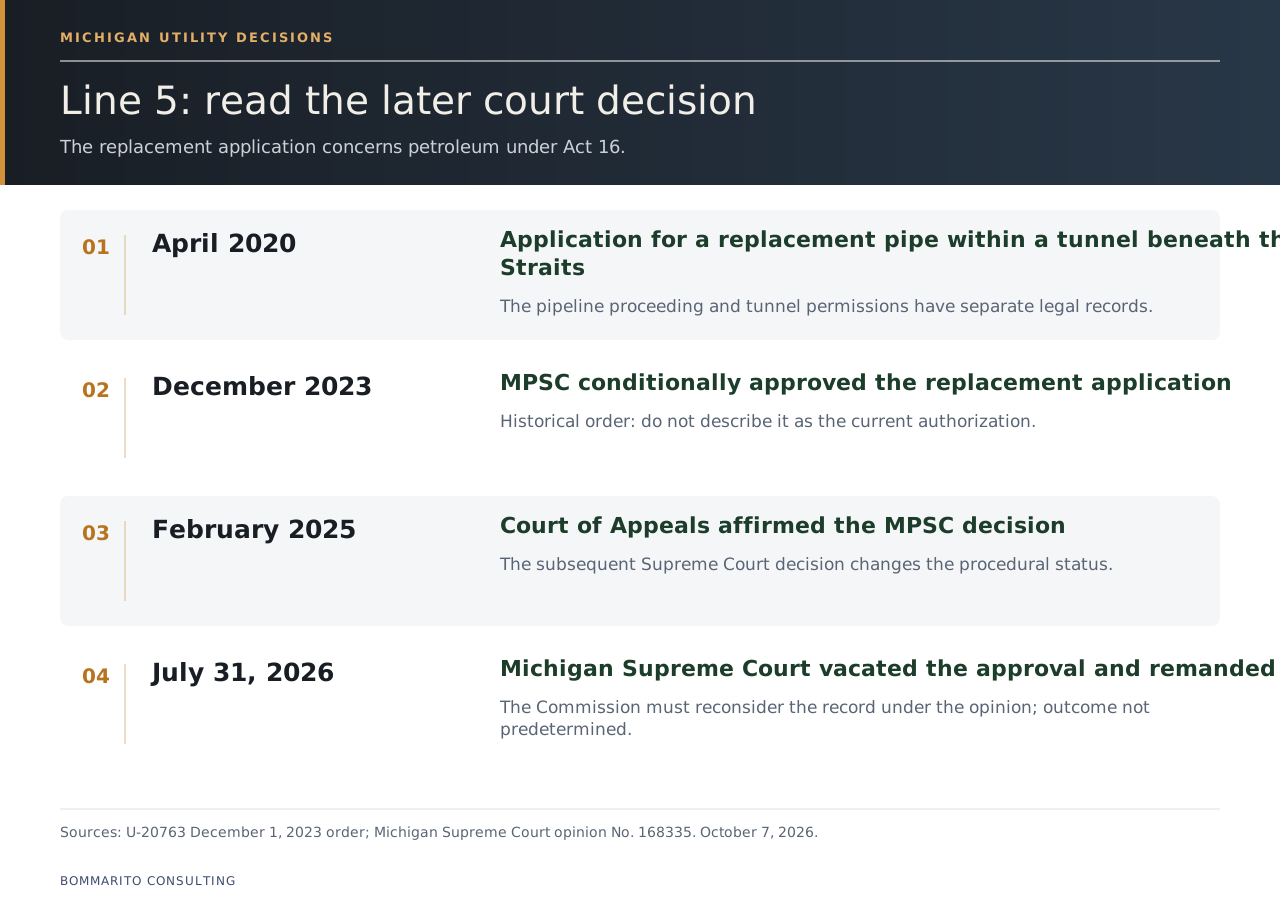
Enbridge applied in April 2020 to replace and relocate the segment crossing the Straits of Mackinac. The proposal would replace two 20-inch pipes with a single 30-inch pipe in a concrete-lined tunnel below the lakebed. The MPSC explains that the application sought approval for the replacement pipeline segment; the tunnel itself required separate applications before other agencies. 8
A broad project label can conceal this separation. The replacement pipe, tunnel excavation, water discharges, wetlands impacts, bottomlands permissions, and the existing pipeline's continued operation can raise connected but legally distinct questions. The court decision also explains why some environmental consequences cannot be excluded simply by describing the application narrowly. 81012
Read the timeline as legal events
| Event | What it establishes | What it does not establish |
|---|---|---|
| April 2020 application | Enbridge requested Act 16 authority | Approval or construction completion |
| December 1, 2023 order | MPSC granted conditional approval at that time | A complete set of all project permits |
| February 2025 appellate decision | Court of Appeals affirmed that order | The end of judicial review |
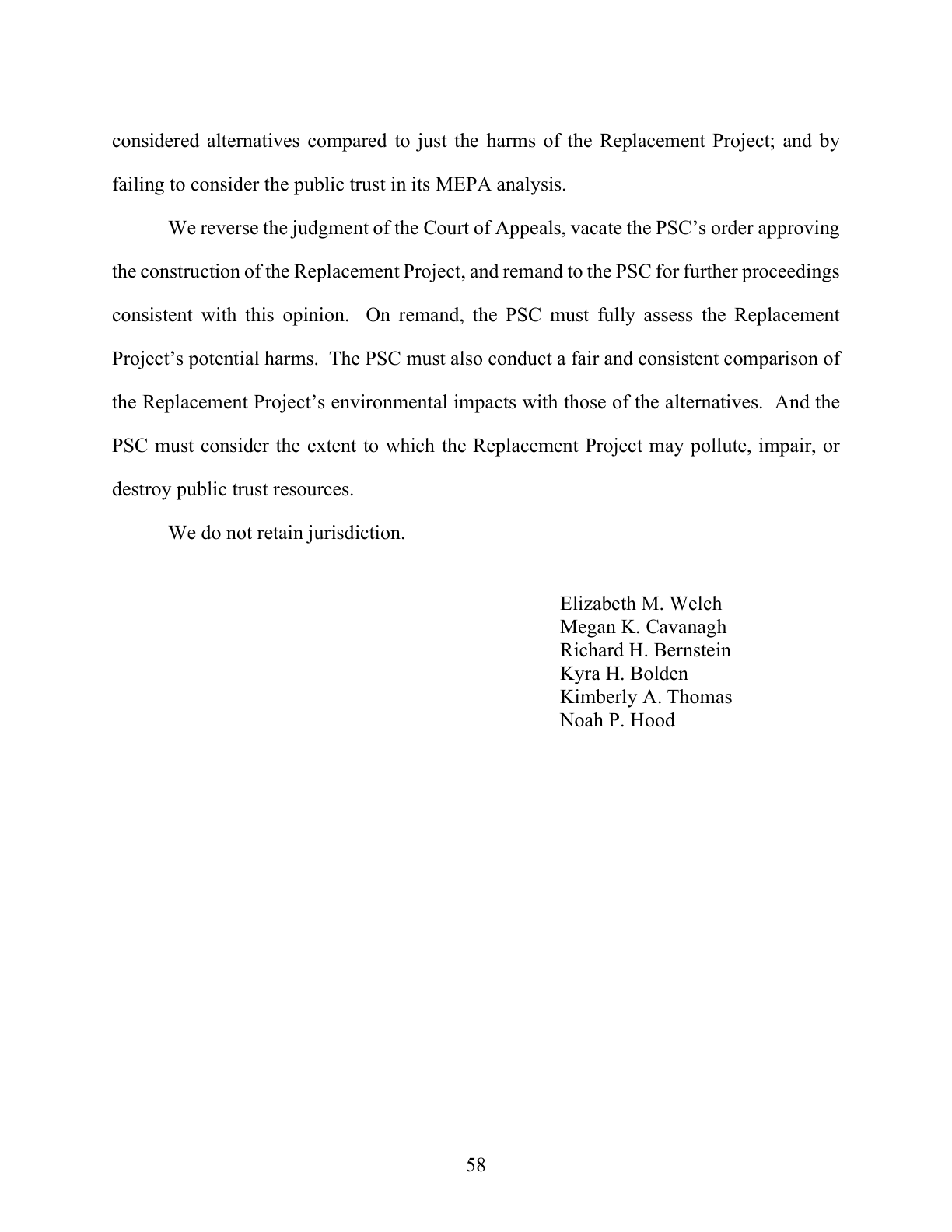
| July 31, 2026 Supreme Court decision | The approval was vacated and the case remanded | A permanent ban on every future proposal |
The opinion is the controlling source for the last event. Older agency background pages and archive order titles can still describe the December 2023 approval. They must be read with the later judicial disposition. 8910
Chapter 4
What the July 2026 court decision changed
Three problems in the earlier analysis
The majority identified problems with causation, comparison of alternatives, and public trust resources. It directed the Commission to assess whether the replacement project would factually and proximately cause an extension of Line 5's operational life and associated environmental harm. “Proximately” concerns the legal connection between the proposed conduct and the harm, beyond merely observing that both exist. 10
The comparison of alternatives also needs a fair and consistent basis. Giving the replacement project one analytical boundary while applying a different boundary to alternatives can distort the result. The court required a reasoned comparison rather than accepting inconsistent treatment. The public trust inquiry concerns resources held for the public, including the Great Lakes; it cannot simply be left outside the analysis. 10
The review standard matters
MEPA, the Michigan Environmental Protection Act, requires consideration of environmental effects in specified agency proceedings. MCL 324.1705 addresses agency determinations, feasible and prudent alternatives, and judicial review. The Supreme Court held that courts review an agency's application of MEPA independently, or “de novo,” regardless of whether the dispute began in court or before an agency. 1011
Keep separate lawsuits separate
Litigation about the existing dual pipelines, the easement, federal removal, and shutdown requests is distinct from this appeal of the MPSC replacement approval. A decision about which court hears a lawsuit does not decide the merits of a siting certificate. This report analyzes the retained Michigan Supreme Court opinion and selected MPSC records; it is not a complete survey of every Line 5 lawsuit or later remand event. 10
The original opinion contains the majority's reasoning and a partial concurrence and dissent. The reporter's syllabus helps readers navigate the document, but the syllabus states that it is not part of the court's opinion. Read the authored opinion and final disposition for the holding. 10
Chapter 5
Safety, environmental permits, and land rights
Siting and safety have different jobs
Siting determines whether and where a specified facility may be constructed under the governing law. Safety regulation addresses design, operation, inspection, maintenance, and incidents within the relevant safety program. The MPSC inspects and enforces requirements for jurisdictional intrastate gas systems. As a federal interstate agent, it conducts gas inspections and investigations and relays findings to PHMSA for enforcement. Its gas-safety program does not oversee hazardous-liquid pipelines. 347
PHMSA is the federal Pipeline and Hazardous Materials Safety Administration. Federal law allows states to assume specified intrastate inspection and enforcement responsibilities through certification. Interstate-agent arrangements retain federal enforcement responsibility. Identify the actual program before deciding where to direct a safety concern. 7
Environmental permissions remain distinct
EGLE's Line 5 permit register identifies water-discharge, wetlands, and Great Lakes submerged-lands matters. An environmental permit concerns the activities and conditions it authorizes. It does not, by its existence, establish that every other permission is effective. Likewise, an MPSC certificate does not supply all required environmental permissions. 812
For a route alternative, ask which wetlands or water crossings it affects, which construction method is proposed, and which permits that method needs. A mapped wetland screen is useful evidence of a possible issue; it is not itself a field delineation, permit grant, or final impact calculation.
Land rights and compensation
Act 9 and Act 16 include provisions concerning rights-of-way and condemnation. Their scope and prerequisites matter. A siting proceeding, an easement negotiation, and a compensation dispute ask different questions. Read the proposed easement's access, restoration, maintenance, assignment, and future-use provisions alongside the approved construction description. 12
::: caution Keep records for each approval Maintain a simple register: the legal question, deciding authority, docket or permit number, requested action, issued decision, conditions, court status, and next deadline. A green check in one column must not erase an unresolved requirement in another. :::
Chapter 6
Construction approval and customer costs
A needed pipe can still require cost scrutiny
Construction authority and permission to charge customers are separate questions. Act 9 includes rate and contract provisions for the carriers it covers. Utility rates and supply-cost proceedings also have their own records. Ask which facilities and customers are included, how the cost was estimated, and where cost recovery will be considered. 13 (section 10)
A forecast is not actual spending. Compare the route's design assumptions, estimate date, contingency, restoration, land rights, and crossing methods. A cheaper-looking route can be misleading if one estimate includes those items and the other does not. Avoid adding a separate component to a planning allowance that already includes it.
Follow the consequences of demand changes
A reinforcement proposal may respond to projected demand, pressure needs, reliability concerns, or a new customer. Ask what happens if the forecast changes. Which expenditures remain useful? Which commitments protect existing customers? A siting order does not itself guarantee bill savings or establish later compliance with every condition.
This guide does not estimate the cost of Line 300 or the Line 5 replacement. It provides a review method and identifies the records needed for a supported estimate. No project cost, household bill effect, or completion date is inferred from route length alone.
Chapter 7
Find the decision and build your evidence
Begin with the legal question
Identify the commodity and proposed work. Find the application, authority asserted, route maps, notice, and case schedule. For an interstate natural-gas proposal, check the FERC certificate record. For the Michigan examples here, use U-22248 for Line 300 and U-20763 for Line 5, then examine the original records. Open MPSC helps locate materials; it does not replace the Commission's official docket or a court's later disposition. 3568910
Choose the form of participation
A public comment tells the agency your concern. Intervention makes you a party that can offer and test evidence under the proceeding's rules. The notice and administrative law judge's schedule set the relevant requirements. A general letter, a Commission meeting comment, and filed testimony are not interchangeable. 13
Build a submission around the decision being made. For route questions, provide a reproducible comparison, maps, constraints, and design questions. For environmental review, identify the effect and alternative requiring analysis. For safety, identify the responsible program and specific concern. For costs, identify the estimate or allocation you are challenging. 14710111213
A record checklist
- Retain the application and original route exhibits.
- State each alternative's endpoints, comparison window, and construction assumptions.
- Use consistent source dates, units, and geographic measurement rules.
- Distinguish public facts, calculations, assumptions, and missing information.
- Track the latest order, conditions, court action, and deadline.
- Keep siting, safety, permits, land rights, and customer costs visible as separate decisions.
Original evidence
Read the documents.
These are rendered pages from the retained original PDFs. Open the full source to read definitions, exceptions, and the complete disposition.
Keep the record together
The detailed report
17 pages with cited chapters, decision diagrams, background illustrations, insets, and a source register.
Sources and primary authorities · 14 records
- 1Act 9 of 1929: natural gas pipelines ↗
Primary source · Checked October 7, 2026
- 2Act 16 of 1929: petroleum pipelines ↗
Primary source · Checked October 7, 2026
- 3MPSC facility siting responsibilities ↗
Primary source · Checked October 7, 2026
- 4Michigan gas pipeline safety program ↗
Primary source · Checked October 7, 2026
- 5FERC interstate natural gas pipeline authority ↗
Primary source · Checked October 7, 2026
- 6Interstate and intrastate natural gas pipelines ↗
Primary source · Checked October 7, 2026
- 7Federal and state pipeline safety authority ↗
Primary source · Checked October 7, 2026
- 8MPSC Line 5 project and case explanation ↗
Primary source · Checked October 7, 2026
- 9Line 5 December 1, 2023 MPSC order, U-20763 ↗
Primary source · Checked October 7, 2026
- 10Michigan Supreme Court Line 5 opinion, July 31, 2026 ↗
Primary source · Checked October 7, 2026
- 11Michigan Environmental Protection Act, MCL 324.1705 ↗
Primary source · Checked October 7, 2026
- 12EGLE Line 5 applicable permits ↗
Primary source · Checked October 7, 2026
- 13MPSC Get Involved ↗
Primary source · Checked October 7, 2026
- 14Open MPSC U-22248: Line 300 application and order-query snapshot ↗
Primary source · Checked October 7, 2026
Prepared by Bommarito Consulting from public statutes, original orders, official court opinions, and agency records. Open MPSC is an independent access layer and is not affiliated with the Commission or State of Michigan. Illustrations explain the process; they do not depict surveyed sites or final engineering designs.