
Michigan utility decisions · October 2026
Michigan solar, wind, and battery siting
Solar, wind, and batteries have different size tests and impacts. Learn the local process, state findings, technical standards, and commitments that last beyond construction.
Find the decision that affects you
Begin with the law,
then follow the evidence.
Identify the facility, the decision maker, and the request. The detailed chapters below connect the governing law to the records and actions that matter.
Watch the explanation
Follow the law,
then the decision.
Branded, narrated explanations with animated diagrams, original documents, and downloadable captions and transcripts.
1:04 · 9:16 vertical
The vertical Short

8:18 · 16:9 wide
The detailed explanation

People and current records
What has actually happened?
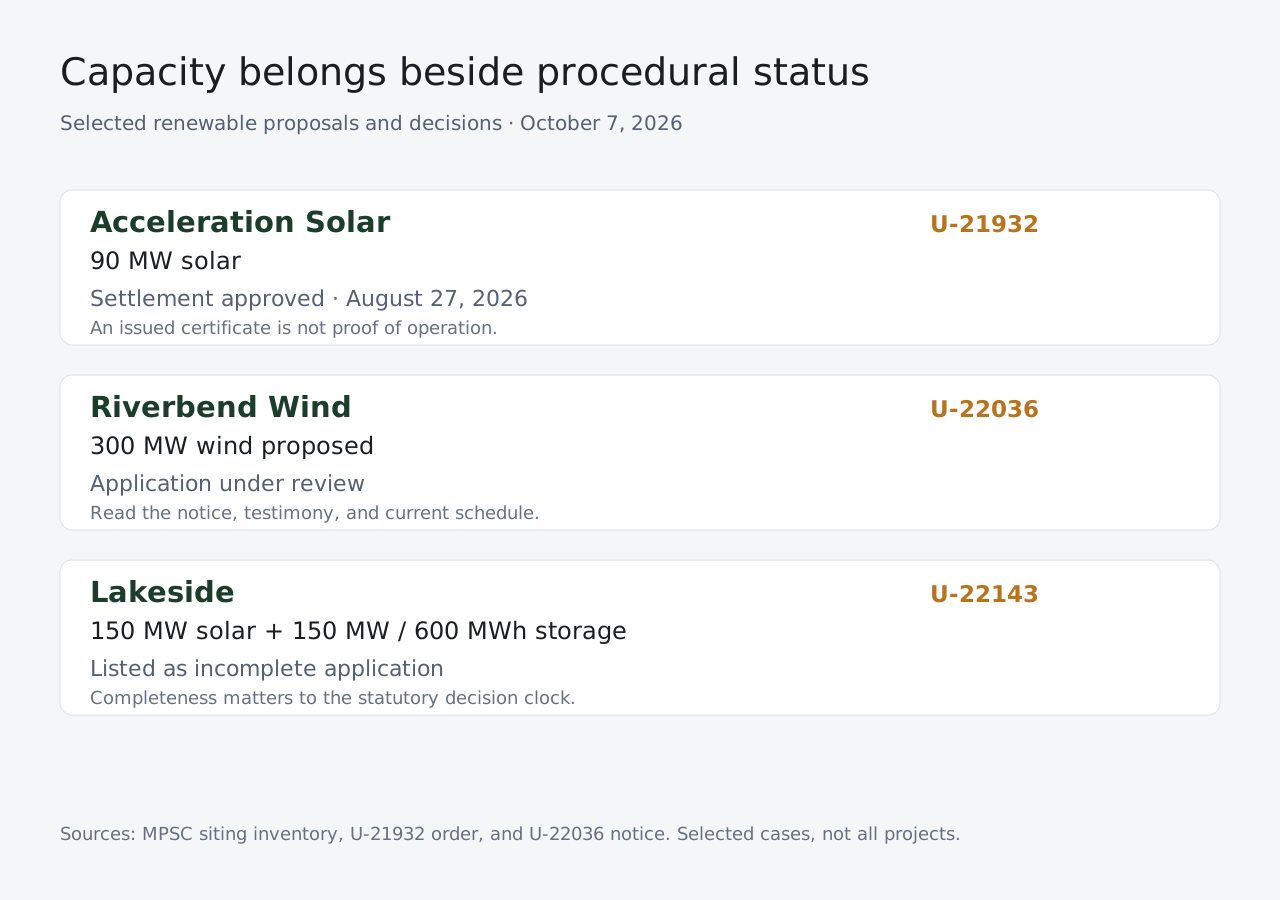
A proposal, certificate, court disposition, and operating facility are different states. Keep the status beside the project name.
90 MW · U-21932
Acceleration Solar
Settlement approved August 27, 2026. A certificate does not establish commercial operation.
300 MW proposed · U-22036
Riverbend Wind
Application under review. Read the procedural schedule and technical record.
Solar + storage · U-22143
Lakeside
Listed as an incomplete application at the October 7 cutoff. The statutory clock depends on completeness.
Evidence cutoff: October 7, 2026. Read the later docket before acting. The source-linked report and chapters identify the controlling records.
A guide you can work through
Read the process
in order.
Start with the foundation, then follow the stages. Each chapter identifies the law and the records behind its claims.
Chapter 1
Start with the facility and the decision
Generation and storage do different work
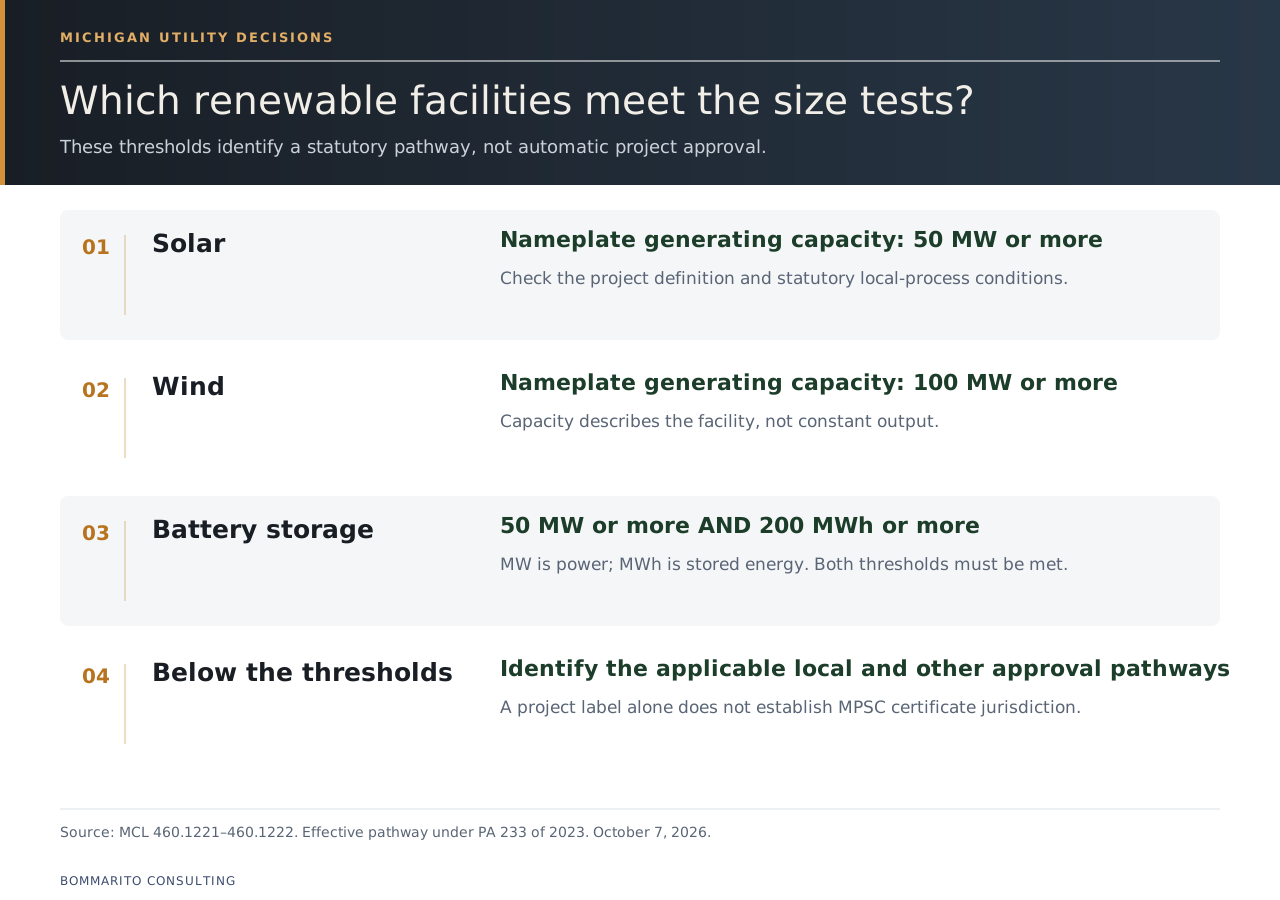
Solar panels and wind turbines generate electricity. A battery stores energy and later delivers power. Megawatts, abbreviated MW, measure power: the rate of producing or delivering electricity. Megawatt-hours, abbreviated MWh, measure energy. A storage project can meet one threshold and miss the other. 12
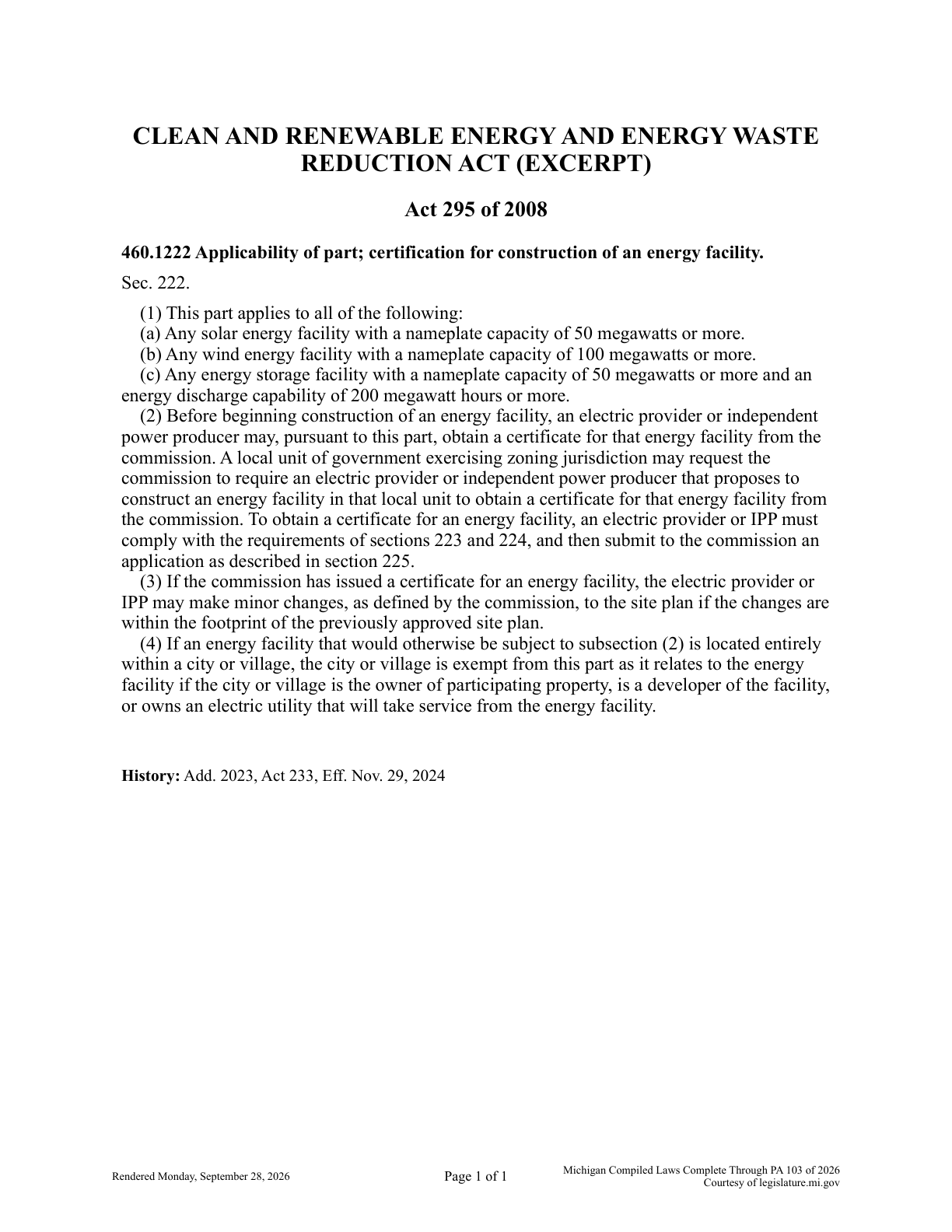
The statute's size tests are at least 50 MW for solar and at least 100 MW for wind. Storage must have at least 50 MW of nameplate power and at least 200 MWh of energy capacity. Both storage tests apply. A 50 MW, 100 MWh proposal fails the energy test; a 40 MW, 400 MWh proposal fails the power test. 2
Dividing 200 MWh by 50 MW gives four hours. That arithmetic explains the relationship between power and energy; it does not guarantee four hours of delivery in every operating condition. Use the application's actual design, usable capacity, and operating assumptions. 12
A facility certificate is one decision
A siting case examines the proposed facility, public benefits, impacts, and statutory requirements. Grid interconnection, environmental permissions, land agreements, and utility cost recovery can involve separate records. Read which decision is being requested before assuming a certificate resolves the whole project. 4589
A landowner who leases property to the developer has a different relationship to the project from a nonparticipating neighbor. The statute uses these distinctions in technical standards and participation provisions. Ask which properties are participating, where the facility boundary lies, and which features establish a setback. 15
Chapter 2
What happens before a state filing
Compatible ordinances preserve a local pathway
A compatible renewable energy ordinance, or CREO, is an ordinance satisfying the statutory compatibility definition. It cannot impose requirements more restrictive than section 226(8). The definition also excludes a locality with a moratorium on developing the covered facilities. An ordinance's title does not establish compatibility. 15
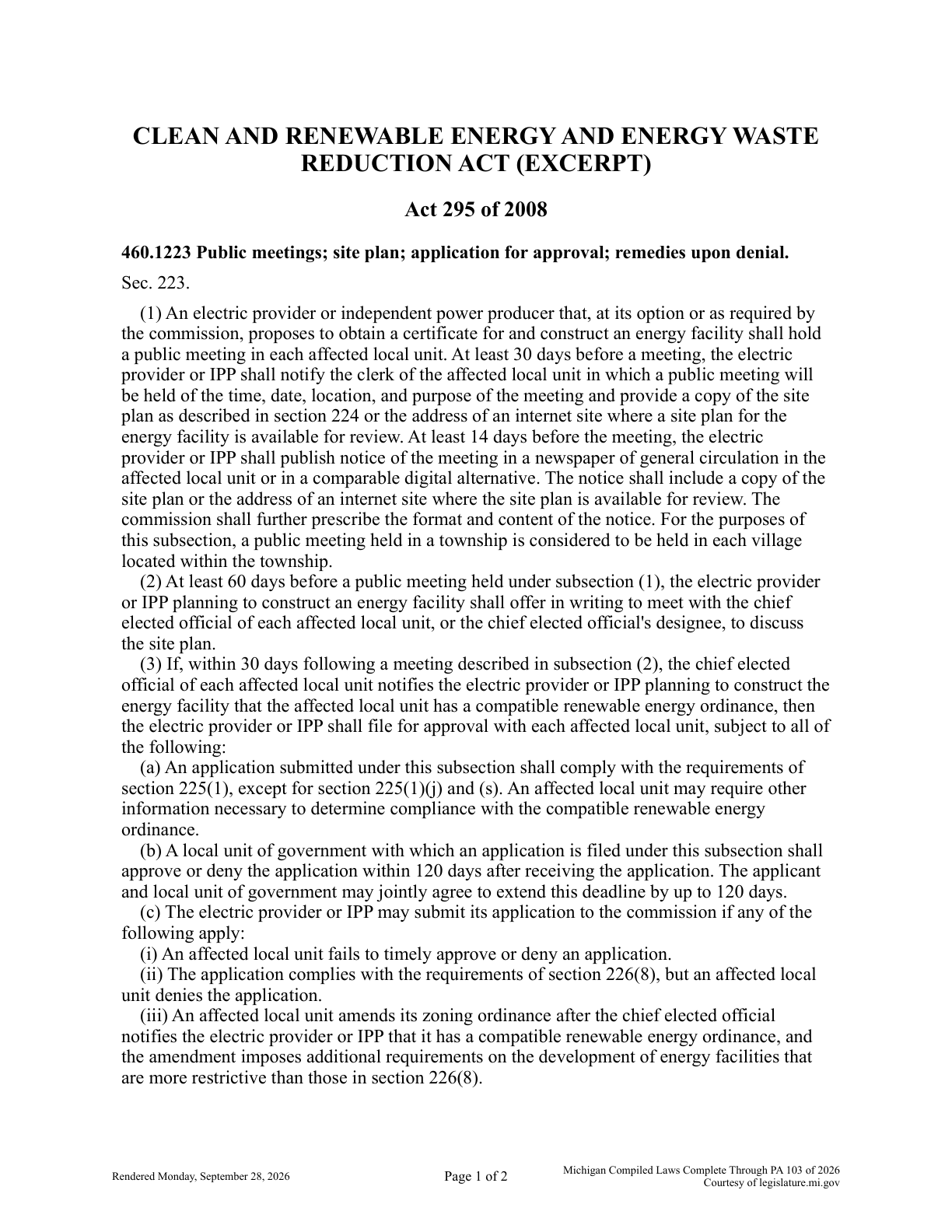
The developer must offer in writing to meet the chief elected official of each affected local unit at least 60 days before the required public meeting. Notice to the clerk precedes the public meeting by at least 30 days, and newspaper or comparable digital notice by at least 14 days. These are different steps with different clocks. 3
The local route applies when the required officials notify the developer of compatible ordinances within the statutory period. A local unit receiving an application under that route must approve or deny it within 120 days. The applicant and local unit may jointly extend that deadline by up to another 120 days. 3
The May 2026 court decision changes how the clocks are read
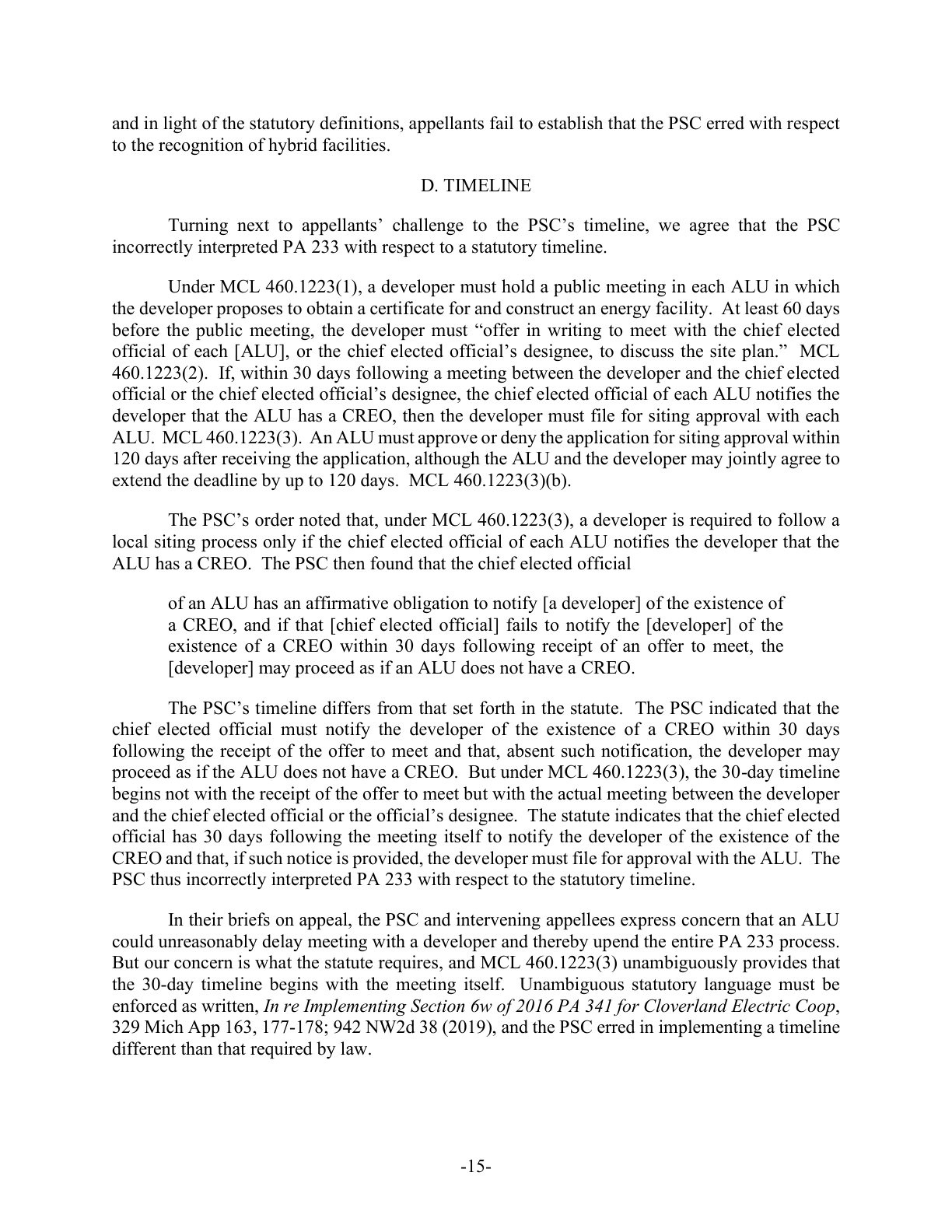
The Court of Appeals' May 7, 2026 opinion, as amended, affirmed parts of the Commission's implementation and reversed others. Read the opinion alongside the October 2024 order; older summaries can contain instructions the court rejected. 1011
The court held that the affected-local-unit definition includes the local units where a project is located, rather than only those exercising zoning authority. It also held that the 30-day CREO notification period runs from the meeting described in section 223(2), rather than merely from receipt of an offer to meet. The offer and the actual meeting are different events. 311
When the applicant can turn to the Commission
The statute identifies circumstances permitting a state application after local review: failure to decide on time, denial despite compliance with section 226(8), or a later ordinance amendment imposing more restrictive requirements. The precise conditions and exemptions must be checked against section 223. A local denial does not automatically resolve every possible legal remedy. 3
The court decision does not erase the local process. It requires that the process be applied under the court's interpretation. This report is not a complete appellate docket audit; later orders or appellate action must be checked before acting. 11
Chapter 3
What the Commission must evaluate
Public benefits require evidence
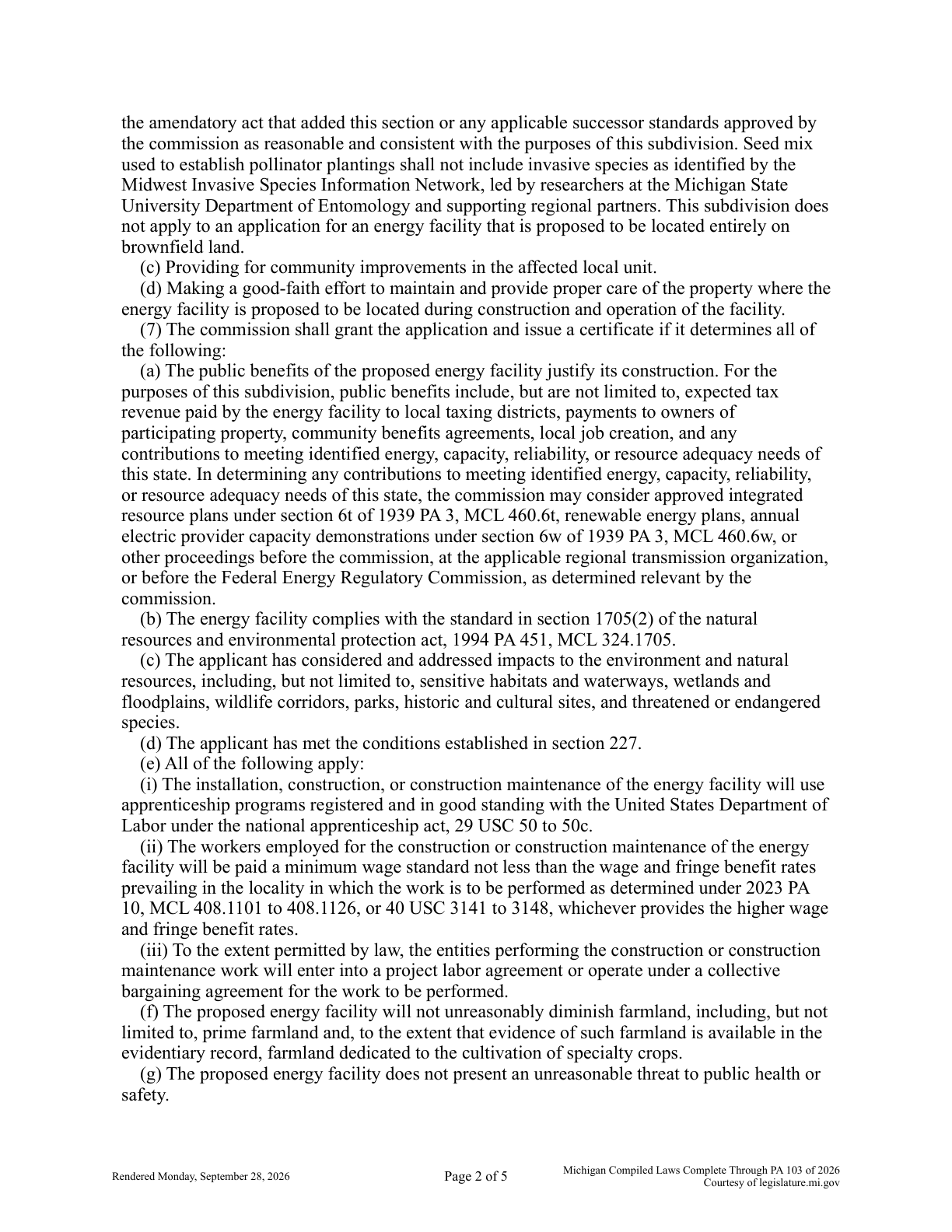
The Commission must find that public benefits justify construction. Statutory examples include tax revenue, participating-owner payments, community benefit agreements, local jobs, and contributions to energy, capacity, reliability, or resource adequacy needs. These are potential benefits to be established in the record, rather than a promise that every proposed facility provides each one. 5
The application must address environmental and natural-resource impacts, including sensitive habitats, wetlands, waterways, floodplains, wildlife corridors, parks, historic and cultural sites, and protected species. Section 226 also incorporates the Michigan Environmental Protection Act standard. Farmland, including prime farmland and identified specialty-crop land, receives an express finding. 45
Construction requirements include registered apprenticeship programs, prevailing wage and fringe-benefit standards, and the statutory labor-agreement provisions to the extent permitted by law. A certificate record must address these requirements as well as the facility layout. 5
Health and safety standards depend on the technology
Solar setbacks are measured from the nearest edge of the perimeter fence. The statute requires 300 feet to occupied community buildings and dwellings on nonparticipating properties, measured to the nearest point on the outer wall. It requires 50 feet to the nearest edge of public-road right-of-way and 50 feet to a nonparticipating shared property line. These reference points matter as much as the numbers. 5
Wind uses blade-tip-height multiples for specified features: 1.1 times that height for listed roads, lines, property boundaries, and participating structures, and 2.1 times for occupied nonparticipating buildings. Its standards also address shadow flicker and noise. Use the statute's actual definitions, measurement rules, and exceptions before drawing a setback circle. 5
Storage has its own applicable setbacks, noise, safety-code, and emergency-response provisions. Solar, wind, and battery facilities are not interchangeable risk profiles. The application's technical documents and section 226(8) determine the applicable requirements. 45
Chapter 4
Payments, removal, and enforceable commitments
Host payments are not automatically annual payments
Section 227 requires an agreement providing payment of $2,000 per MW of nameplate capacity located in an affected local unit, upon commencement of operation. The statutory amount is not described as a recurring annual payment. Tax revenue, lease payments, and negotiated community benefits are separate amounts with their own terms. 6
If a local unit refuses the statutory agreement, the law provides a community-benefits alternative. The Commission enforces the certificate requirement to have the applicable agreement; enforcement of the agreement itself is addressed through the statutory court mechanism. Read the actual agreement before promising how a payment will be used. 6
End-of-life plans belong at the beginning
The application requirements include a decommissioning plan and financial assurance. Decommissioning means removing the facility and addressing the site when operation ends. A written promise and a funded assurance are different things. Ask about the amount, security instrument, inflation assumptions, review intervals, and responsibility if ownership changes. 4
An energy-storage application also must include the applicable emergency-response plan. Local responders need facility-specific information and coordination, rather than a generic assertion that batteries are safe. The statute and application requirements supply the actual review framework. 45
A certificate can override conflicting local restrictions
Section 231 addresses the effect of a Commission certificate on conflicting local ordinances and similar restrictions. That effect attaches to the relevant certificate and facility; it is not a general abolition of local government. Other statutory permissions, land rights, and certificate conditions still require attention. 7
Keep the order, approved plans, conditions, and later compliance submissions together. A revised design can create a different question from the project that originally received approval. 4578
Chapter 5
Three facilities, three procedural states
Acceleration Solar: an issued decision
The Commission approved a settlement concerning the 90 MW Acceleration Solar project in U-21932 on August 27, 2026. The project involves three Ingham County townships. Read the original order for the approved arrangement and conditions. An approved certificate is not proof that construction or commercial operation has occurred. 1213
Riverbend Wind: an application under review
Riverbend's U-22036 record describes a proposed 300 MW wind facility with 50 turbines in Sanilac County. The notice and current siting inventory establish the proposal and proceeding. They do not establish final approval. Use the docket's later schedule to identify the next evidence deadline. 814
Lakeside: solar and storage in one proposal
The Commission's current inventory describes U-22143 as a 150 MW solar proposal with 150 MW and 600 MWh of storage. At the October 7 cutoff, its application is listed as incomplete. An incomplete application is especially important when interpreting the one-year decision clock: the statutory clock runs after a complete application is filed. 58
These examples illustrate different technologies and procedural stages. They are not a complete inventory of every Michigan renewable project. Open MPSC helps locate filings and orders; official orders and the current court record establish legal effect. 8121314
Chapter 6
Put the right evidence in the right record
Comments and intervention do different work
A public comment identifies a concern. Intervention gives a person or entity a formal role as a party in the contested case, subject to its schedule and procedures. Section 226 gives affected local units and participating and nonparticipating property owners intervention rights. Other requests depend on applicable rules. 515
Upon filing an application, the statutory grant to local units supports participation through a local intervenor compensation fund. The Commission determines the amount, subject to caps of $75,000 per local unit and $150,000 total. Section 223 contains exemptions for specified applications following local review, so the grant should not be assumed available in every filing. 35
Start with an answerable question
For a setback concern, identify the measured feature and property status. For a wetland concern, identify the map source and field information. For removal, request the assurance calculation and enforceable instrument. For public benefits, distinguish project claims from evidence and approved commitments. 456
Read the application, its completeness determination, the procedural order, and any later amendment. Keep the court interpretation alongside the implementation order. Then identify the decision maker and deadline for the specific relief sought. 345101115
The useful sequence is facility, pathway, standards, evidence, decision, and compliance. Capacity alone cannot tell you where to participate or what the Commission still needs to decide.
Original evidence
Read the documents.
These are rendered pages from the retained original PDFs. Open the full source to read definitions, exceptions, and the complete disposition.
Keep the record together
The detailed report
16 pages with cited chapters, decision diagrams, background illustrations, insets, and a source register.
Sources and primary authorities · 15 records
- 1Renewable siting definitions, MCL 460.1221 ↗
Primary source · Checked October 7, 2026
- 2Renewable siting eligibility, MCL 460.1222 ↗
Primary source · Checked October 7, 2026
- 3Local process and public meetings, MCL 460.1223 ↗
Primary source · Checked October 7, 2026
- 4Site plan and consultations, MCL 460.1224 ↗
Primary source · Checked October 7, 2026
- 5Contested case, findings, and facility standards, MCL 460.1226 ↗
Primary source · Checked October 7, 2026
- 6Community benefit agreement, MCL 460.1227 ↗
Primary source · Checked October 7, 2026
- 7Certificate effects, MCL 460.1231 ↗
Primary source · Checked October 7, 2026
- 8MPSC renewable and storage siting register ↗
Primary source · Checked October 7, 2026
- 9MPSC renewable siting general questions ↗
Primary source · Checked October 7, 2026
- 10U-21547 October 10, 2024 implementing order ↗
Primary source · Checked October 7, 2026
- 11Court of Appeals PA 233 opinion, May 7, 2026, as amended ↗
Primary source · Checked October 7, 2026
- 12MPSC Acceleration Solar issue brief, U-21932 ↗
Primary source · Checked October 7, 2026
- 13Acceleration Solar settlement order, August 27, 2026 ↗
Primary source · Checked October 7, 2026
- 14Riverbend Wind hearing notice, U-22036 ↗
Primary source · Checked October 7, 2026
- 15MPSC Get Involved ↗
Primary source · Checked October 7, 2026
Prepared by Bommarito Consulting from public statutes, original orders, official court opinions, and agency records. Open MPSC is an independent access layer and is not affiliated with the Commission or State of Michigan. Illustrations explain the process; they do not depict surveyed sites or final engineering designs.