Start here
The vertical Short
1 minute 21 seconds

Michigan utility decisions · October 7, 2026
A new line. A higher bill. A huge new customer.
Who decides, who pays, and how you can participate.
Act 30 governs transmission siting. The Commission's broader work reaches rates, pipelines, renewable facilities, large-load contracts, and the service people rely on.
Two ways to begin
Begin with the law and the agency: what Act 30 covers, what the MPSC does, and how its decisions affect you. The full video focuses on electric transmission: public benefits, feasible and reasonable routes, competing objectives, and the evidence behind a route comparison.
1 minute 21 seconds
7 minutes 45 seconds
Both videos include captions and downloadable transcripts.
Start with the decision
One project can have several approvals. Choose a concern to find the relevant law and the next useful record.
Act 30
May the line follow this route?
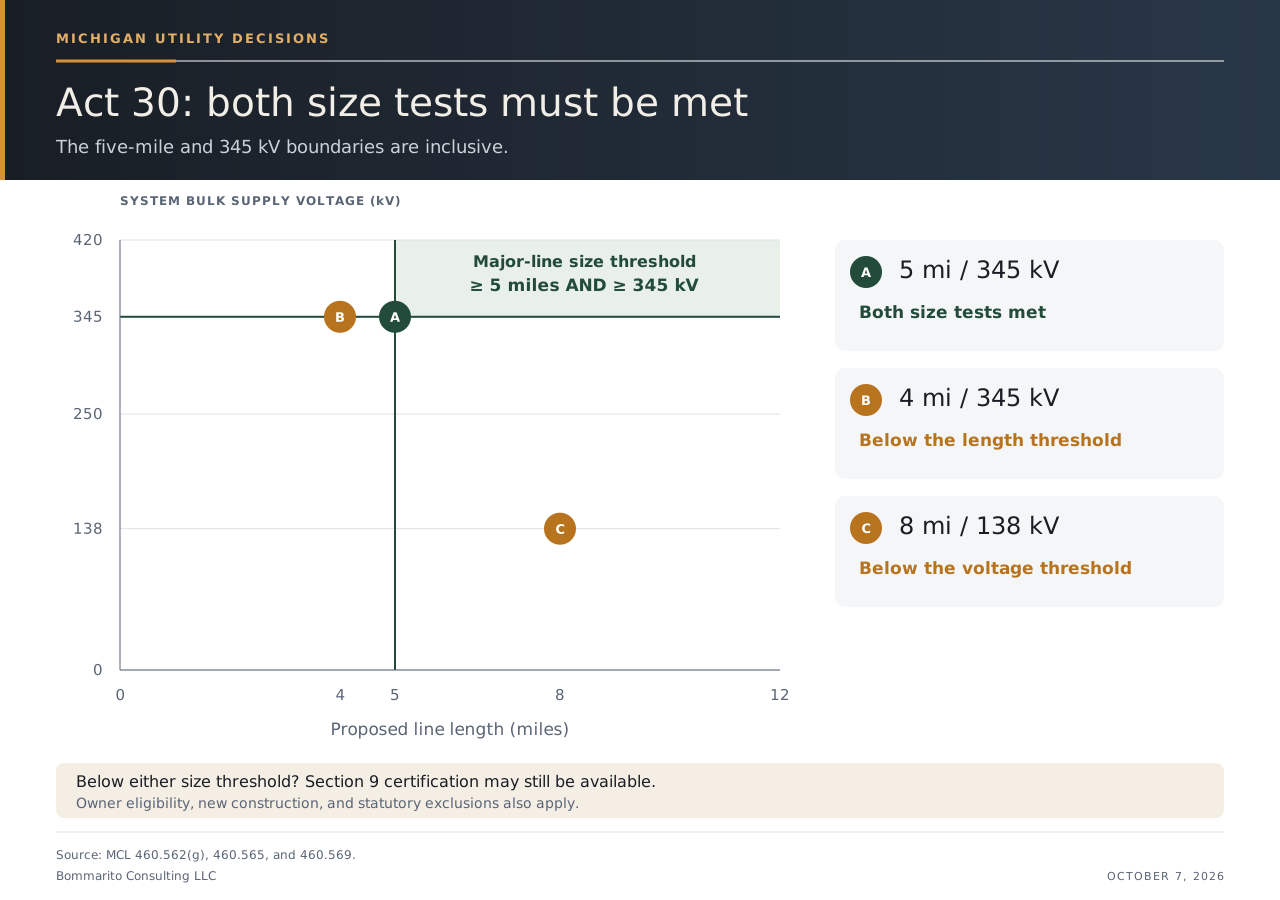
Check the owner, construction type, voltage, and length. Eligible new major lines meet both thresholds: at least five miles and 345 kV. Smaller lines can seek a section 9 certificate.
Rate and cost recovery proceedings
Which costs may the utility recover?
A rate case tests the revenue request, investment, financing, and allocation among customers. Your own bill depends on your tariff and use. Municipal utilities and member-regulated cooperatives have rate exceptions.
Tariffs, special contracts, plans, and cost recovery
Who pays if demand changes or the customer leaves?
Look at contracted demand, ramp-up, minimum billing, dedicated facilities, collateral, and termination payments. A service contract is separate from the project's land-use, water, and environmental approvals.
Acts 9 and 16 of 1929
Is the pipeline needed, reasonably routed, and safe?
Intrastate natural gas siting uses Act 9. Crude oil and petroleum pipeline siting uses Act 16. Interstate natural gas siting is a federal FERC matter. Safety oversight is another layer.
PA 233 state siting option and local process
Does the state siting pathway apply?
The option covers solar at 50 MW or more, wind at 100 MW or more, and storage at 50 MW or more with at least 200 MWh of discharge capability. Local-process conditions and statutory triggers also apply.
Service, reliability, distribution, and rate proceedings
What must the utility improve, and who pays?
Distribution plans address local wires and investment. Resource plans address future supply. Reliability standards and emergency procedures address service and response. A plan is distinct from approved cost recovery.
Telecommunications and video franchise laws
Does the MPSC have authority over this dispute?
Oversight includes wireline and provider disputes and certain cable matters. Michigan no longer regulates retail telecom rates. Cellular, broadband, and internet services are generally excluded; some associated issues overlap with regulated functions.
The transmission certificate
For an eligible new major line, the MPSC must find that public benefits justify construction, the route is feasible and reasonable, and health and safety are protected. The applicant must accept any conditions. 7
The legal definition includes five miles or more and 345 kV or more. Owner eligibility and construction exclusions also apply. 2 3
Check eligible ownership and the proposed construction. This is a size screen, not a complete legal determination.
Below either threshold, a section 9 certificate may still be sought. Repairs, replacements, improvements, and added circuits have statutory exclusions. 3 4
Quantifiable and nonquantifiable benefits must justify construction.
Engineering, corridor constraints, impacts, and alternatives need evidence.
The line must not present an unreasonable threat.
The applicant must accept conditions in a conditional grant.
From legal findings to comparable evidence
Feasibility asks whether an alignment can work. Reasonableness asks whether its choice is justified by the record and alternatives. A score helps explain competing objectives; it does not decide either legal finding.
These are evidence categories, not a statutory checklist or a claim that every layer is complete. The Oneida–Sabine method groups related concerns and discloses missing information. Wetland and hydric indicators can overlap; new-corridor penalties can duplicate co-location credits.
Try the comparison
Four invented routes use the same measurements. Each quantity is divided by a stated scale: 15 miles, 20 homes, and 16 wetland acres. The remaining weight is split equally between homes and wetlands.
Homes: 33.3% · Wetlands: 33.3%
B has the lowest illustrated score: 0.525.
| Route | Miles | Homes | Wetland acres | Score |
|---|---|---|---|---|
| A | 10 | 18 | 14 | 0.814 |
| B | 12 | 8 | 6 | 0.525 |
| C | 15 | 20 | 16 | 1.000 |
| D | 11 | 10 | 9 | 0.599 |
C is worse on all three measurements than A, B, and D. It is dominated under this example. A, B, and D have competing advantages. The legal decision still needs the unmeasured constraints and full record.
Publish raw quantities, scales, weights, category budgets, and contribution breakdowns. Test uncertain layers and different priorities. A winning share from a weight sweep depends on the sampled weights.
Named routes and all graph paths are different populations. A divergence-and-rejoin window answers a local question. Report whole-route results too, and explain how the window was chosen.
Download the illustrative inputs and calculations → · These are not actual Oneida–Sabine route measurements.
Read the certificate findings, application requirements, and voluntary guidance alongside the analytical example. 7 6 10
Before the route is final
A public comment identifies a concern. Intervention gives an eligible participant a formal role in the contested evidence process, with duties and deadlines. Follow the case's actual schedule. 7 36
A certificate can take precedence over conflicting local restrictions and have effects in later proceedings. It does not set your easement payment. 8
Follow the money
A certificate includes an estimated cost. Rate and cost recovery proceedings test financial treatment. Federal transmission cost allocation has its own role. 7 15 39
DTE Electric's U-21860 order authorized $242.406 million in additional annual revenue after an initial request of about $574.1 million and a revised request of $562.6 million. 16
The authorized amount is about 42.2% of the original request. Those are utility-wide annual revenue figures. Your household bill depends on its tariff and use.
Download the comparison data ↓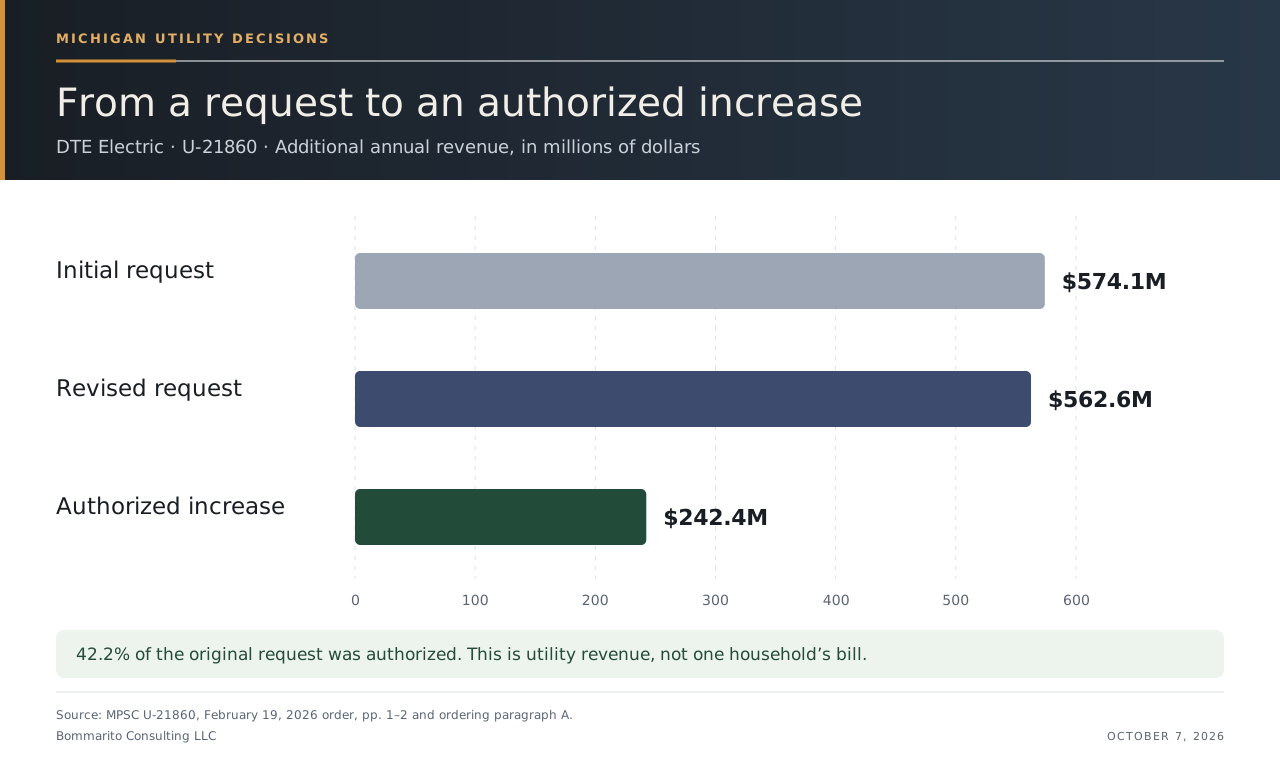
Try the arithmetic
At full contracted capacity for a year, average use changes the energy total. Move the slider to see the calculation. This is an illustration, not a forecast.
1,383 MW × 8,760 hours × assumed use ÷ 1,000,000
Assumes all contracted capacity is available for the full year. Omits ramp-up, outages, and curtailment. The 80% minimum billing demand is a financial term, not an annual-energy promise. 17
Download the illustrative scenarios ↓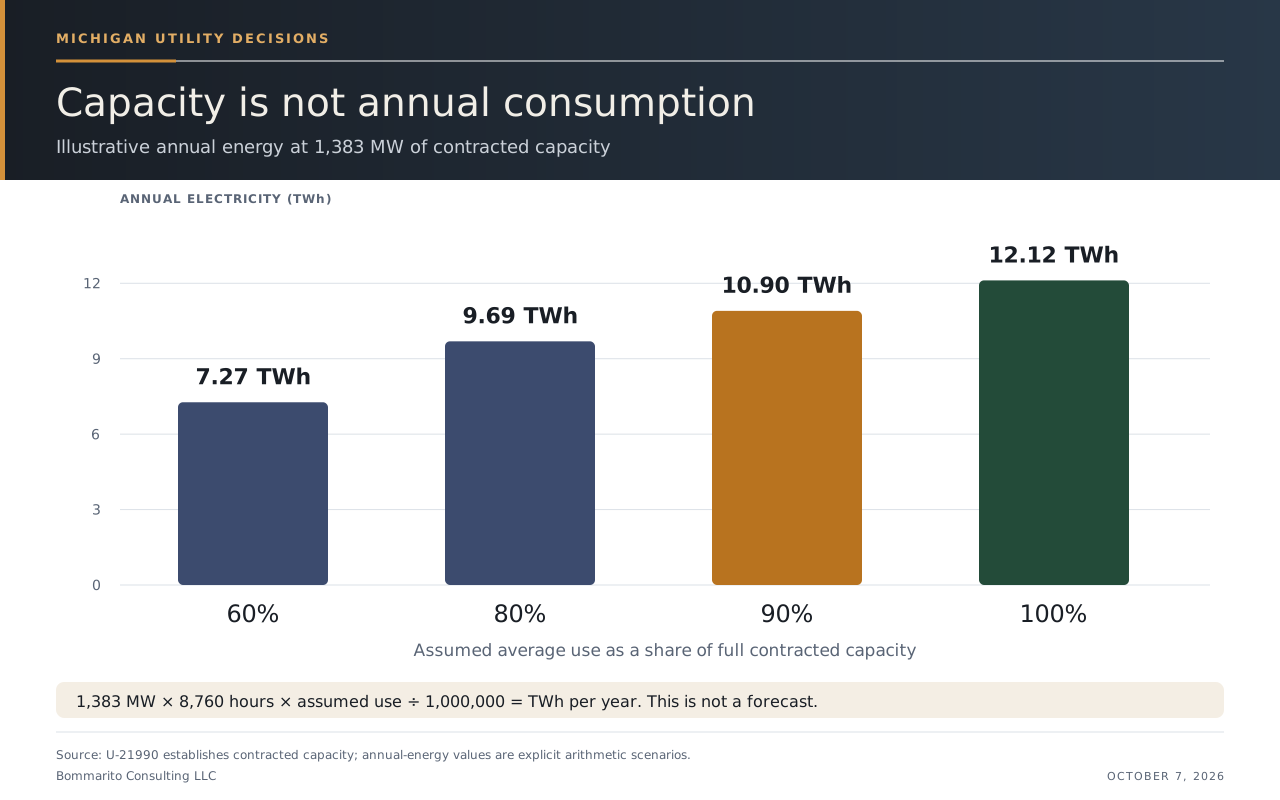
Service in an emergency
U-22059 approved modified DTE tariff terms for shedding qualifying large loads before other customers when that would prevent firm load shedding for those customers. Check the tariff's eligibility and conditions. 19
A separate large-load design
U-22058's October 1, 2026 decision uses a primary supply agreement and a clean capacity accelerator agreement, with conditions and reporting. It is a different contract record from Saline. 20
Current through October 7, 2026
The filing guidelines, proposed rules, and highway bill have different legal status. They address different parts of the process.
Act 30 filing guidelines
Adopted January 29, 2026 for applications filed from April 29. Recommendations cover engagement, invitations, notice, routes, and existing corridors. 10
Administrative filing rules
Proposed R 460.51–460.58 would require engagement and route information, including priority for existing rights-of-way in scoring. Later adoption and effective dates need verification. 11
Limited access highway utility use
The House-passed bill would change aboveground collocation rules. Official history shows Senate committee referral, with no enactment in the October 7 review. 13
| Subject | Voluntary guidelines | U-22064 proposal |
|---|---|---|
| Meeting timing | Six-month lead recommended | Six-month lead would be required |
| Notice after filing | Broader tiered radius recommended | Specified affected-property set and maps |
| Route suggestions | Consider reasonable changes | Consider and document reasonable changes |
| Existing rights-of-way | Priority in weighting and scoring recommended | Priority in scoring would be mandatory |
| Party alternatives | 45 days after prehearing recommended | That provision not found in proposed text |
Meeting invitations and application notice are separate phases. Neither column replaces the current statute. 5 7 10 11
The highway question
Act 30 tests the route. Highway law and transportation approvals determine whether a utility can occupy highway land. An existing-corridor preference does not supply an MDOT permit or prove available width. 7 12 14
Read the detailed HB 5940 analysis →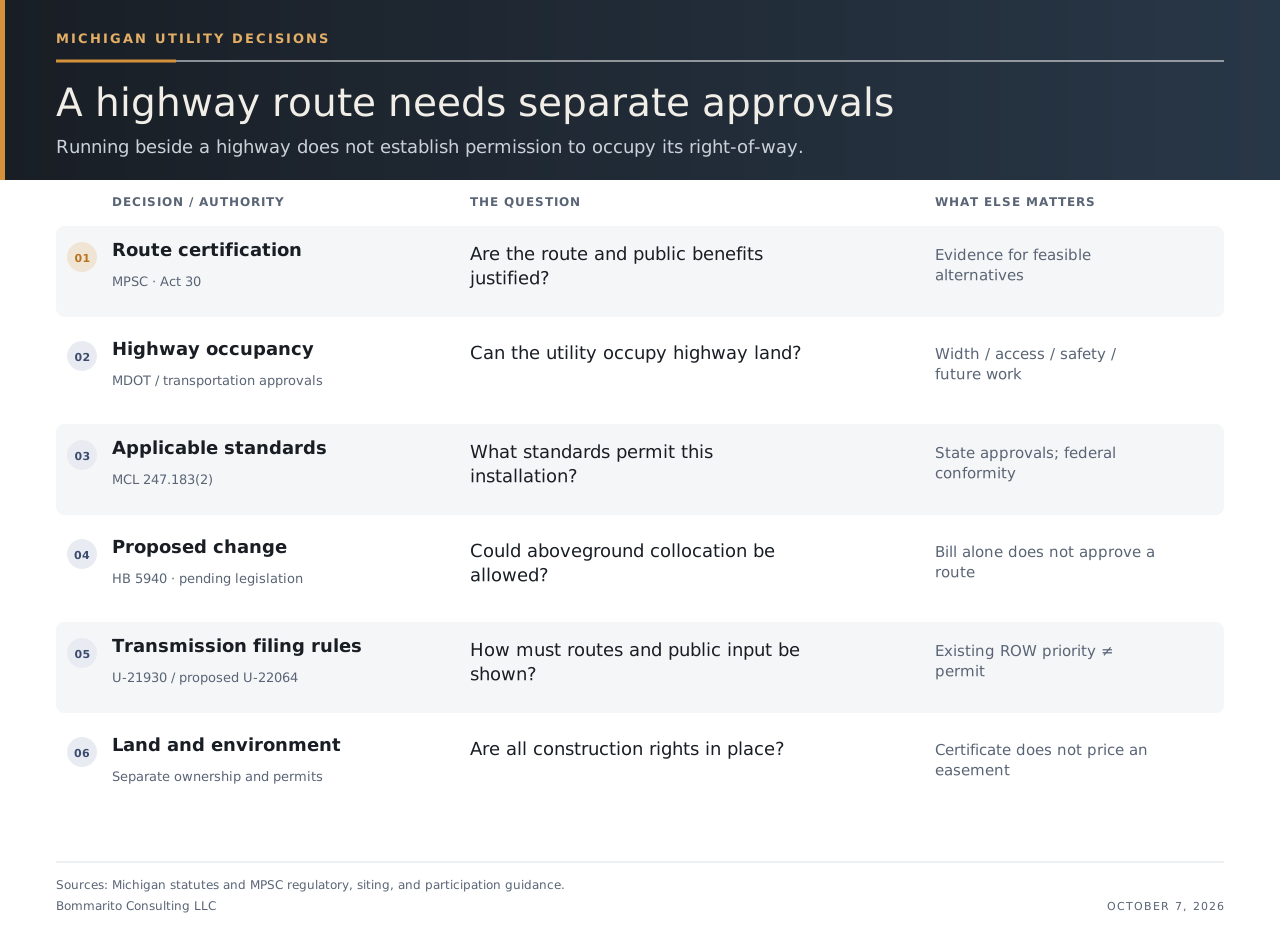
Go to the record
These selected proceedings show how different decisions work. They are not a complete inventory, a construction-status tracker, or a finding about pending appeals.
10 selected cases
Certificate issued July 10, 2025; the record helped prompt engagement guidelines.
Archive status: Closed. This does not establish construction or appeal status. Checked 2026-10-07.
Certificate issued July 10, 2025; a separate transmission route proceeding.
Archive status: Closed. This does not establish construction or appeal status. Checked 2026-10-07.
Adopted January 29, 2026; applicable to filings from April 29. Voluntary guidance.
Archive status: Closed. This does not establish construction or appeal status. Checked 2026-10-07.
Hearing October 21 at 10 a.m. ET; written comments due 5 p.m. ET. Proposed, not effective rules.
Archive status: Open. This does not establish construction or appeal status. Checked 2026-10-07.
Conditional approval December 18, 2025; rehearing and reopening denied March 27, 2026.
Archive status: Closed. This does not establish construction or appeal status. Checked 2026-10-07.
Modified tariff terms approved August 27, 2026 for qualifying large loads.
Archive status: Closed. This does not establish construction or appeal status. Checked 2026-10-07.
Contracts approved with conditions October 1, 2026; distinct from Saline.
Archive status: Closed. This does not establish construction or appeal status. Checked 2026-10-07.
$242.406 million added annual revenue authorized February 19, 2026.
Archive status: Closed. This does not establish construction or appeal status. Checked 2026-10-07.
August 27, 2026 settlement approval for a 90 MW project under PA 233.
Archive status: Closed. This does not establish construction or appeal status. Checked 2026-10-07.
Filed September 28, 2026. The API returned no Commission order as of October 7.
Archive status: Open. This does not establish construction or appeal status. Checked 2026-10-07.
No Commission order returned in this API snapshot.
No matching cases. Clear the search or change the decision type.
Download source-linked case data ↓Questions people ask
Act 30 concerns transmission certificates. A line serving a data center may involve Act 30, while the customer's electric contract, rates, resource needs, local zoning, and other permits use their own processes. 2 17 21
Yes. MCL 460.562(g) says five miles or more, paired with at least 345 kV and the specified owner categories. Check construction exclusions too. The statutory language is more precise than the MPSC overview's paraphrase. 2 3
Act 30 gives affected landowners and municipalities full intervenor status as of right. Follow the docket's procedural requirements and deadlines. A public comment does not automatically make you a party in the evidentiary process. 7 36
No. A certificate has specified legal effects on route approval, local conflicts, and related proceedings. Land rights and compensation remain distinct questions. The route proceeding can determine issues that matter later. 8
The order assigns customer-caused costs and remaining exposure to the customer or DTE under its conditions. Applicant projections of bill benefits are not a guarantee of a future household bill. Actual costs and allocation still need monitoring. 17
Read and check the evidence
Public records reviewed through October 7, 2026. The selected court authorities include the 2017 Oshtemo order and earlier transmission opinions; this is not a comprehensive citator review.
Ten chapters, diagrams, insets, source citations, and a practical project guide.
Primary-source register ↓45 authoritiesSource links, legal status, and the date checked.
Calculation inputs ↓Explicit assumptionsDTE annual-revenue comparison and illustrative energy scenarios.
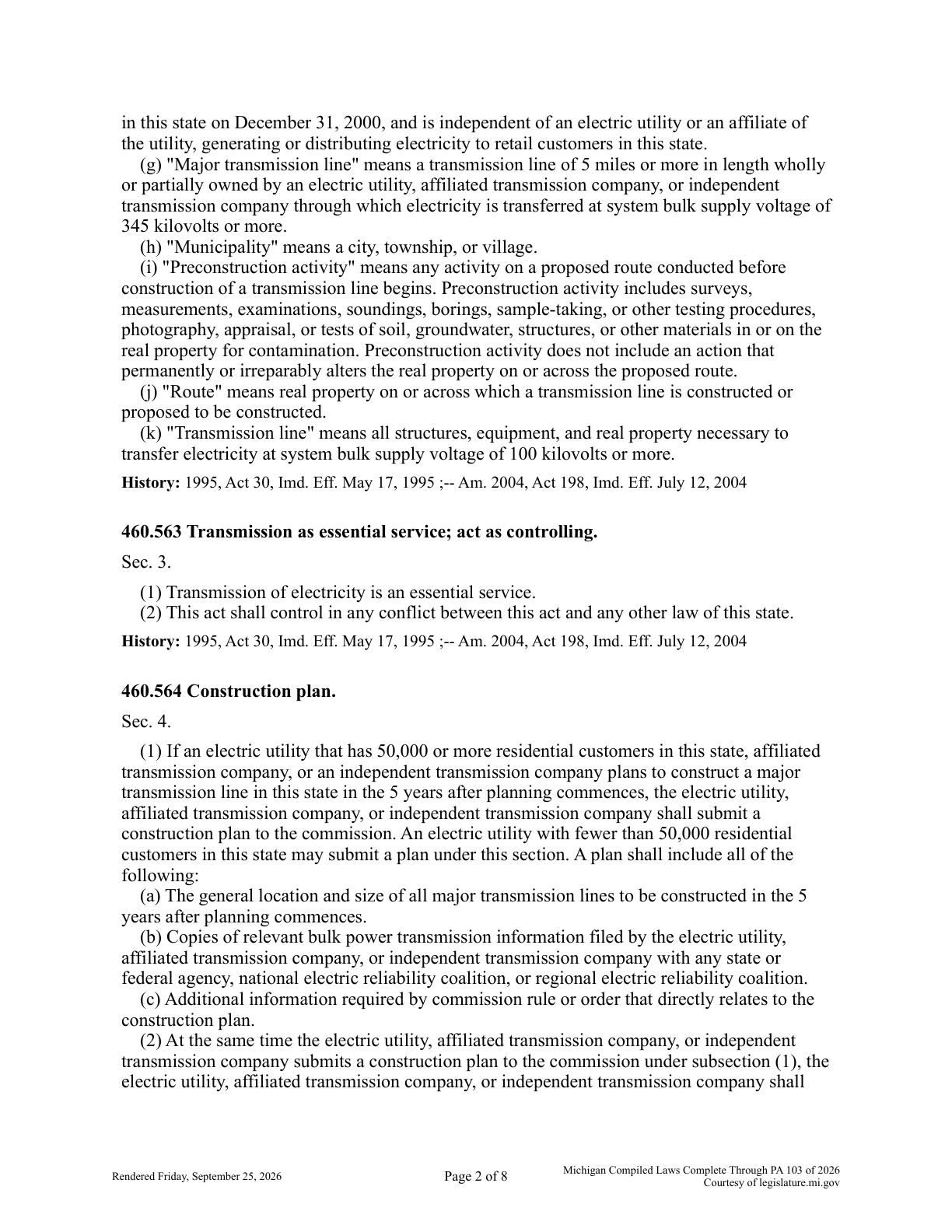
Definition · PDF page 2
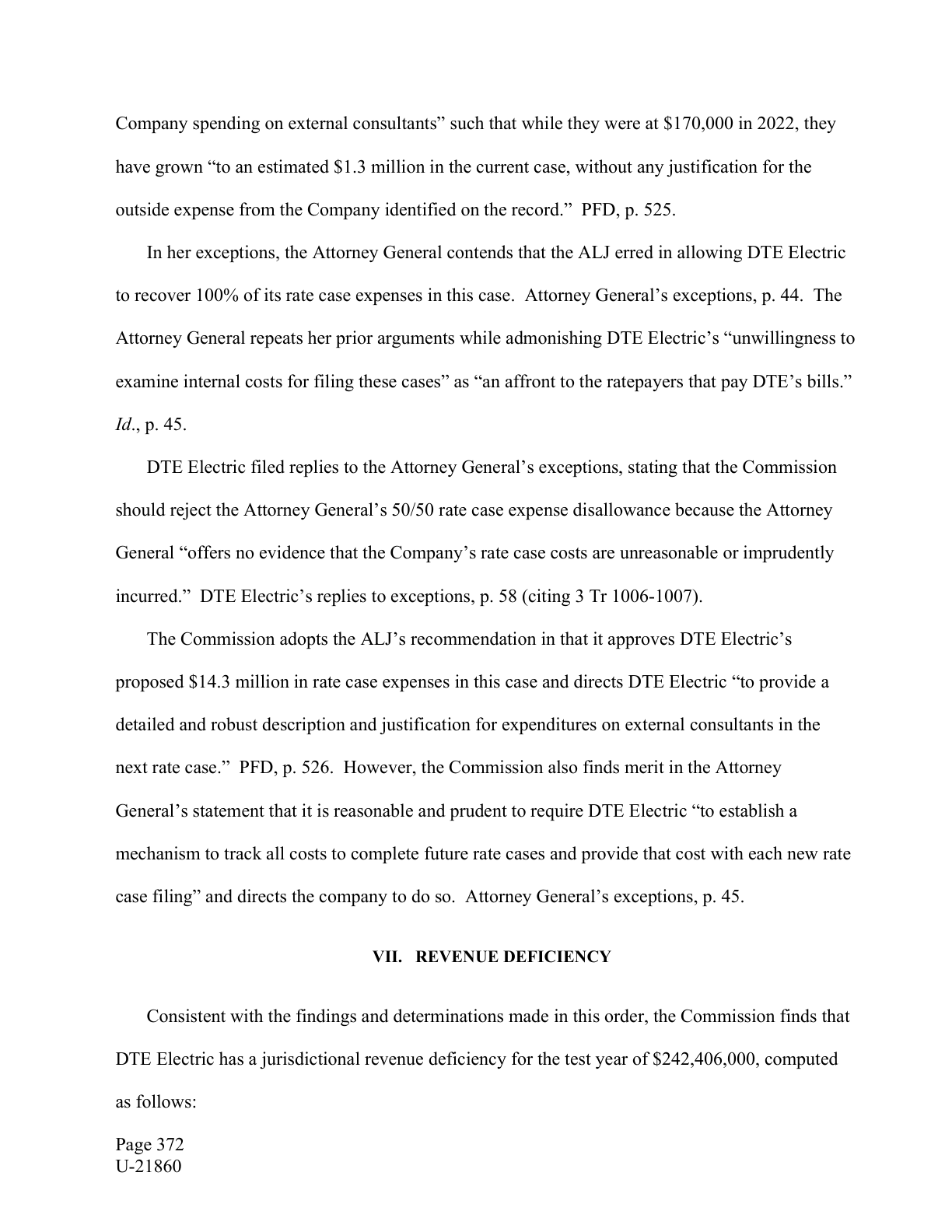
Revenue finding · PDF page 374
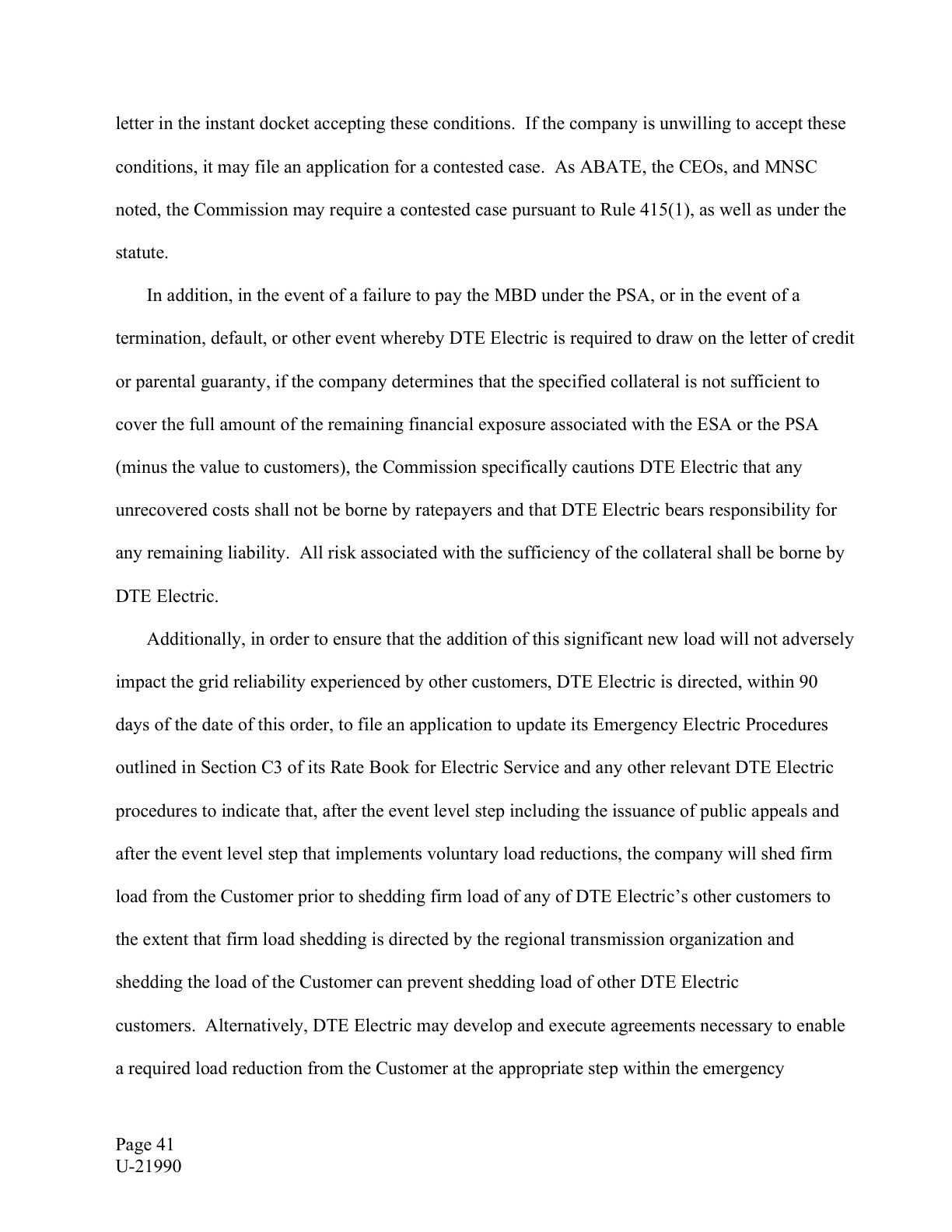
Remaining liability · PDF page 41
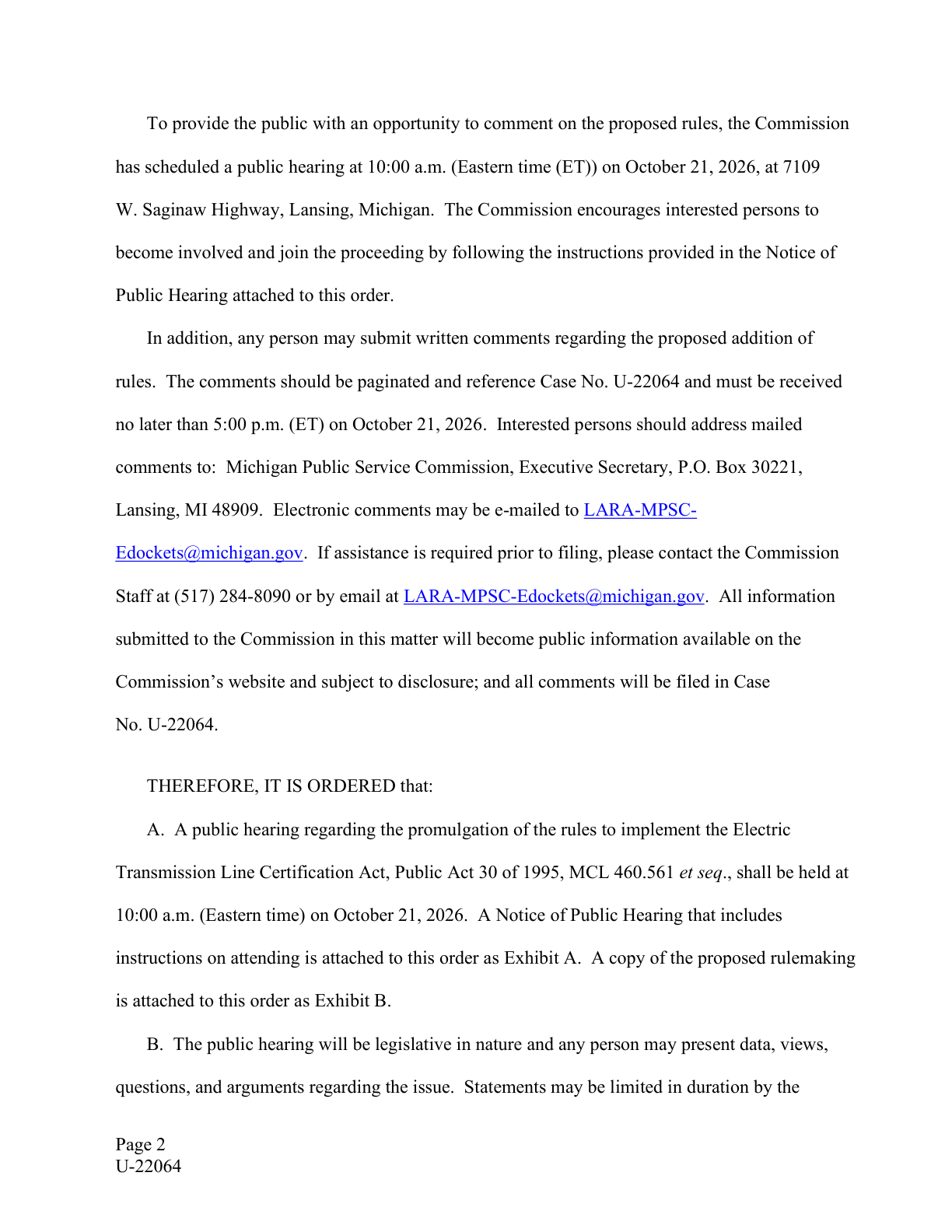
Hearing and comments · PDF page 2
agency overview · Checked 2026-10-07
current law · Checked 2026-10-07
current law · Checked 2026-10-07
current law · Checked 2026-10-07
current law · Checked 2026-10-07
current law · Checked 2026-10-07
current law · Checked 2026-10-07
current law · Checked 2026-10-07
current law · Checked 2026-10-07
pp. 55–56; Attachment A, guidelines 2.1–2.10, 3.1–3.2, 4.10–4.12 · issued order · Checked 2026-10-07
pp. 1–3; Exhibits A and B, proposed R 460.51–460.58 · proposed rules · Checked 2026-10-07
current law · Checked 2026-10-07
pending bill; history rechecked · Checked 2026-10-07
agency policy; saved sibling copy · Checked 2026-10-07
current law · Checked 2026-10-07
pp. 1–2; revenue deficiency and final ordering provisions · issued order · Checked 2026-10-07
pp. 4–8, 31–42, and ordering provisions · issued order · Checked 2026-10-07
order denying rehearing, reopening, and contested proceeding · issued order · Checked 2026-10-07
approved DTE emergency tariff revisions · issued order · Checked 2026-10-07
conditional primary supply and clean capacity accelerator agreements · issued order · Checked 2026-10-07
current law · Checked 2026-10-07
agency overview and reports · Checked 2026-10-07
agency overview · Checked 2026-10-07
current law · Checked 2026-10-07
agency overview · Checked 2026-10-07
current law · Checked 2026-10-07
current law · Checked 2026-10-07
printed pp. 1–21; read with the 2017 Supreme Court order · published appellate opinion · Checked 2026-10-07
p. 1: narrow constitutional ground for affirmance · Supreme Court order · Checked 2026-10-07
printed pp. 338–355; expedited wind transmission certification · published appellate opinion · Checked 2026-10-07
current law · Checked 2026-10-07
printed pp. 180–181: review standard and Rovas principle · published appellate opinion · Checked 2026-10-07
p. 97: existing corridors; pp. 114–116: engagement and filing guidelines · issued order · Checked 2026-10-07
major transmission certificate · issued order · Checked 2026-10-07
agency overview · Checked 2026-10-07
participation guidance · Checked 2026-10-07
agency overview · Checked 2026-10-07
agency overview · Checked 2026-10-07
federal overview · Checked 2026-10-07
PA 233 settlement for 90 MW solar facility · issued order · Checked 2026-10-07
case opened September 28, 2026; no order in API result on October 7, 2026 · filed application; merits unresolved · Checked 2026-10-07
official text and history checked October 7, 2026 · legislative proposal · Checked 2026-10-07
official text and history checked October 7, 2026 · legislative proposal · Checked 2026-10-07
official text and history checked October 7, 2026 · legislative proposal · Checked 2026-10-07
official text and history checked October 7, 2026 · legislative proposal · Checked 2026-10-07
Prepared by Bommarito Consulting from public statutes, orders, court publications, and related research. Open MPSC is an independent access layer and is not affiliated with the Commission or State of Michigan. Applicant claims, calculated illustrations, issued decisions, and proposed changes are identified separately. Project-specific legal questions depend on the governing records and deadlines.
Insights by email
One email when we publish something new, and nothing when we don't. No tracking pixels, and leaving takes one click.
Working on something like this? Talk to us →